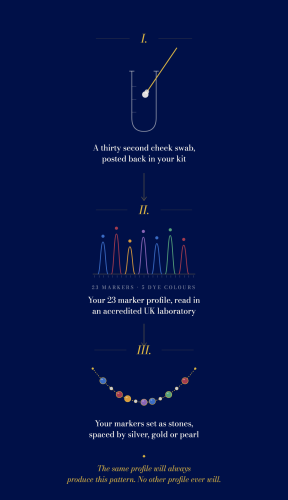
DNA profiling — also called genetic fingerprinting or DNA typing — is a laboratory technique that analyses specific regions of an individual’s DNA to produce a unique genetic identifier. First developed in 1984, it is used today in forensic science, medical genetics, and paternity testing. At DesigNA, it is the science that makes every DNA jewellery piece unrepeatable.
What is DNA?
DNA (deoxyribonucleic acid) is the molecule that carries the genetic instructions for the development, functioning, and reproduction of all known living organisms. In humans, DNA is organised into 23 pairs of chromosomes, located in the nucleus of virtually every cell in the body.
The human genome contains approximately 3 billion base pairs of DNA. Around 99.9% of this sequence is identical between any two unrelated humans. It is the remaining 0.1% — roughly 3 million base pairs — that makes each person genetically unique. DNA profiling focuses on this variable 0.1%.
How Does DNA Profiling Work?
DNA profiling does not sequence your entire genome. Instead, it analyses a small number of specific regions of your DNA called Short Tandem Repeats (STRs) — locations in the genome where a short sequence of DNA (typically 2–7 base pairs long) is repeated a variable number of times.
The number of repeats at each STR location varies significantly between individuals. By measuring the repeat count at multiple STR locations simultaneously, a laboratory can generate a profile that is unique to a specific person.
The Key Steps in DNA Profiling
- DNA Extraction: DNA is extracted from a biological sample — in DesigNA’s case, cheek cells from a swab. The cells are lysed (broken open) and the DNA is purified away from other cellular material.
- PCR Amplification: The STR regions of interest are amplified using the Polymerase Chain Reaction (PCR) — a technique that creates millions of copies of a specific DNA region, ensuring there is sufficient material to analyse even from a small sample.
- Gel Electrophoresis: The amplified DNA fragments are separated by size as they migrate through a gel under an electric current. Shorter fragments travel further and faster; longer fragments move less. This produces a visible banding pattern.
- Profile Generation: The resulting band pattern across multiple STR loci is recorded and interpreted. This is your DNA profile — a pattern as unique as a fingerprint, but determined at the molecular level.
How Unique is a DNA Profile?
The statistical uniqueness of a DNA profile depends on the number of STR loci analysed. The UK’s National DNA Database (NDNAD) uses a 20-locus profile system. The probability of two unrelated individuals sharing an identical profile across all 20 loci is estimated at less than 1 in 1 billion.
For practical purposes, a full DNA profile is considered unique to an individual. Even identical twins — who share the same underlying DNA sequence — can show minor differences in their profiles due to somatic mutations and epigenetic changes that occur independently after conception.
Who Invented DNA Profiling?
DNA profiling was invented by Professor Sir Alec Jeffreys at the University of Leicester in September 1984. He later described the moment of discovery as seeing “an astounding result” on an X-ray film showing the unique banding patterns of his own family members’ DNA side by side.
The technique was first used in a criminal investigation in 1986 to exonerate an innocent suspect and subsequently identify the real perpetrator. It has since become foundational to forensic science, medical testing, and genetic research worldwide. The same science that helps solve crimes and reunite families is the science behind every DesigNA necklace.
What is the Difference Between DNA Profiling and DNA Sequencing?
These are often confused but are quite different techniques:
- DNA profiling analyses a small number of specific repeat regions of the genome to produce a unique identifier. It does not read your full genetic code and reveals nothing about your health, ancestry, or inherited traits.
- DNA sequencing (such as that done by consumer testing companies) reads a much larger portion of the genome and can reveal information about health predispositions, ancestry, and physical traits.
DesigNA uses profiling rather than sequencing. This means we generate a unique design pattern from your DNA without reading your full genetic code — a more privacy-preserving approach that is focused entirely on what makes you biologically unique rather than what your genome might reveal about you.
Is DNA Profiling Safe and Private?
The cheek swab collection process is entirely non-invasive. No blood, tissue, or medical procedure is required — just a simple swab of the inside of the cheek. The profiling is carried out in a laboratory under strict data protection protocols.
At DesigNA, your DNA data is used only to generate the unique pattern for your jewellery design. It is never sold, shared with third parties, or retained after the design is complete. Read our full DNA privacy policy for complete details.
How Does DesigNA Use DNA Profiling to Create Jewellery?
Once your DNA profile is generated in the laboratory, our design team translates the band patterns and STR marker data into a physical jewellery design. Each data point — the position and intensity of each band, the allele size at each locus — corresponds to the placement of a specific stone or bead along the necklace.
The result is a design determined entirely by your genetic data. No two profiles produce the same design. No two necklaces are alike — not because of a designer’s choice, but because of biology.
Learn more about the science at DesigNA, or explore our DNA profile necklace collection.


