

Journal · Science
The science of DNA uniqueness.
Why no two genomes produce the same DesigNA piece, even for siblings or identical twins, with the underlying biology explained clearly.
What we read
The human genome contains around three billion base pairs. The vast majority is shared across all humans. What makes individuals different is a small set of variations, including single nucleotide polymorphisms (SNPs) and short tandem repeats (STRs).
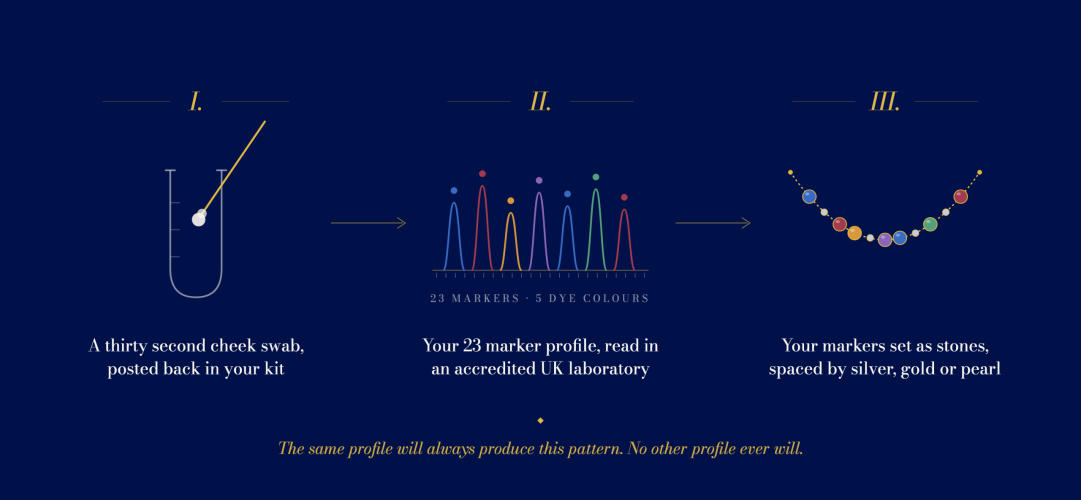
DesigNA reads a curated set of markers chosen for their design properties. These markers vary widely between individuals but do not encode any clinical, ancestral, or behavioural information. They are useful precisely because they are uninformative medically and highly variable visually.
Why each design is unique
When you combine multiple variable markers, the number of possible outputs becomes astronomical. Even reading a small number of polymorphic markers produces more unique combinations than there are people who have ever lived. In practice, the probability of two unrelated people producing the same DesigNA design is effectively zero.
Twins, siblings, and the limits
Identical twins share around 99.9 percent of their DNA. Most consumer genetic tests cannot distinguish between them. DesigNA can, because we read markers including microsatellite regions that mutate at higher rates than the rest of the genome. The result is that twins produce noticeably different DesigNA designs.
Siblings, parents, and children share less DNA (around 50 percent on average), so their designs differ much more visibly. We have made DesigNA pieces for entire families, and the necklaces sit together as a related but distinct set, much like the family itself.
What it does not tell you
Worth restating clearly. A DesigNA necklace is a design output, not a diagnostic, predictive, or ancestral report. We do not read disease risk markers. We do not generate an ancestry breakdown. We do not store enough of your genome to do either later.
Why this matters for the wearer
Most personalised jewellery is meaningful because of what is engraved or chosen. A DesigNA piece is meaningful because of what is read. The wearer did not select the arrangement, biology did. The piece is therefore an honest record of a single person at a single moment, captured in stones and metal, certified, and impossible to duplicate.
See how it works
A four part series on DNA jewellery
The lab side, the design side, the craft side, and the certificate. Sent over a week. No discount, no pressure.
We will never share your email. Unsubscribe anytime.
Written by Oliver Sullivan, founder of DesigNA, with input from our partner laboratory. Updated May 2026.


