

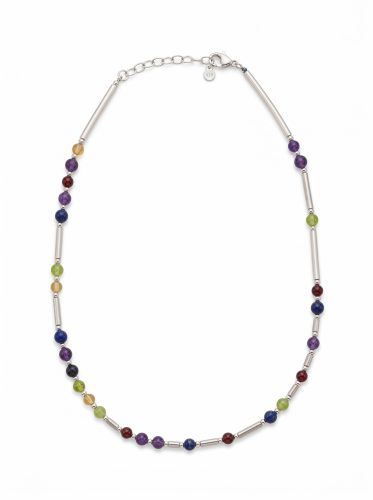
Engraved and nameplate necklaces have become the most searched personalised jewellery style in the UK this year, and it is easy to see why. A name, initial, or date on a pendant feels intimate. It is also a familiar, affordable way to mark a relationship. However, a dna necklace vs engraved necklace comparison reveals a real difference in what “personal” actually means. It is worth understanding before you choose a gift.
In this guide, we look at how a jeweller makes each piece, what makes each one unique, and which suits different occasions. As a result, you can pick the option that matches the message you want to send.
What Is an Engraved or Nameplate Necklace?
A nameplate necklace carries a name, word, or set of initials cut or stamped into metal. Engraving adds a message, date, or coordinates onto a pendant, chain, or bar. A jeweller’s tool or a laser marks the metal in both styles, and the result is attractive, readable, and instantly personal in the everyday sense of the word.
The technique stays straightforward, so engraved and nameplate pieces are widely available and often quick to produce. Many buyers choose them for exactly this reason. The turnaround is fast, and the message reads clearly at a glance. However, the same name or word can appear on more than one necklace, because the personalisation lives in the choice of text, not in anything unique to the wearer’s body.
What Is a DNA Necklace?
A DNA necklace works differently. First, you send a simple sampling kit, and the person swabs their cheek at home. Next, a UK laboratory analyses specific markers from that sample. Finally, our design team translates the resulting genetic pattern into a pendant design, and our partner jeweller in Birmingham crafts the final piece.
Because every person’s DNA differs, the pattern on a DesigNA necklace is not a design choice. It records that person’s own genetic code directly, so no other necklace can ever repeat it. You can read the full process in how your DNA becomes a necklace.
The Core Difference: Chosen Text vs Genetic Fact
An engraved necklace personalises through what you decide to write. Therefore, its meaning comes from the words themselves, a name, a date, or a phrase that matters to you. This is a valid and moving form of personalisation, and it works well for many gifts.
A DNA necklace personalises through what the wearer biologically is. Nobody chooses their own genetic pattern, and nobody else on earth carries the same one. In short, an engraved necklace says “this is what I want to say about you,” while a DNA necklace says “this is, literally, you.”
For example, two friends could each buy an identical nameplate necklace engraved with the same name. However, two people could never end up with the same DNA necklace pattern, because the science makes that impossible.
Durability and Everyday Wear
Engraved text can wear down over years of contact with skin and clothing. This happens most often on softer metals or shallow engraving. As a result, some nameplate pieces need re-engraving or replacement after heavy daily use.
DesigNA necklaces use durable materials throughout the range. Silver is 925 sterling, gold is 9ct with gold filled spacers, and the pearl variant pairs a freshwater pearl with sterling silver. The pattern itself forms part of the pendant’s design, not a surface engraving. Therefore, it does not fade or wear the way stamped text can.
Price and What You Are Actually Paying For
Nameplate and engraved necklaces vary widely in price, largely because the personalisation step is fast and low cost. A jeweller or laser engraver can complete the work in minutes once the design is fixed.
A DNA necklace costs more to produce, and the price reflects that. DesigNA pieces start from £299. This covers the sampling kit, UK laboratory analysis, design work, and handcrafting. Consequently, you pay for a genuine scientific process, not only for materials and craftsmanship. First, the lab does real analysis. Next, our design team does real translation work. Finally, a jeweller does real handcrafting. None of those steps can be skipped to hit a lower price point.
Which One Should You Choose?
Choose an engraved or nameplate necklace if you want a quick, familiar gift built around a name, date, or short message, and if budget is the main constraint. It is a genuinely thoughtful format, and there is nothing wrong with choosing it.
Choose a DNA necklace if you want the deepest possible version of personal. A DNA necklace belongs to one person alone, because it comes from their own genetic code. This suits milestone gifts such as anniversaries, weddings, or a gift to mark a parent or child. The sentiment becomes “there is only one of you,” not just “this has your name on it.”
Explore the full range in the DesigNA shop, including the silver, gold, and pearl variants. Compare them against our buyer’s guide if you want the full picture before deciding.
For context on how DNA identification works more broadly, the UK’s Forensic Science Regulator publishes plain English guidance on genetic markers. It explains the same underlying principle that makes a DNA necklace pattern one of a kind.
FAQ
Is a DNA necklace more personal than an engraved necklace?
Both are personal in different ways. An engraved necklace reflects a name or message you choose. A DNA necklace reflects a genetic pattern unique to the wearer, so nobody else can ever have the same one. If you want personalisation based on the wearer’s own biology rather than chosen text, a DNA necklace goes further.
Does the DNA pattern fade like engraving can?
No. Our design team builds the pattern into the pendant during manufacture, rather than stamping or lasering it onto the surface afterwards. Because of this, it does not wear down the way shallow engraving can after years of daily contact with skin and clothing.
Can two people have the same DNA necklace pattern?
No. The pattern comes directly from an individual’s genetic markers. Because no two people share the same DNA, the resulting pattern differs for every person. Two people could easily order matching nameplate necklaces, but never a matching DNA pattern.
How long does a DNA necklace take compared to an engraved one?
A jeweller can often finish an engraved or nameplate necklace in days. A DNA necklace takes longer, typically one to two weeks from the sampling kit’s return. This is because it involves laboratory analysis and design work rather than surface engraving alone.
Is a DNA necklace worth the extra cost over an engraved necklace?
That depends on what you want to say with the gift. If the message is about a name or date, an engraved necklace delivers that well at a lower price. If the message is about the wearer’s own unique identity, the laboratory process behind a DNA necklace makes that possible. The price from £299 reflects real scientific and craft work.
Your genetic code, profiled from a simple cheek swab and handcrafted into the exact DesigNA necklace. No two are ever the same.


