DNA Bracelet or DNA Necklace: Which Should You Choose?
Share
Both pieces begin in exactly the same place. A cheek swab, a laboratory, 23 identity markers read from your DNA, and a design laid out in the order your own profile puts them. Nothing about the science changes between the two.
What changes is everything after that. How close the piece sits to you. How often you look at it. Who else sees it. And, not least, what it costs. This is a straight comparison, written to help you pick rather than to push you toward the more expensive one.
The short answer
Choose the necklace if you want the piece to be the thing people notice, and if you like the idea of something you put on deliberately.
Choose the bracelet if you want to see your own profile during the day, and if you would rather wear something you never take off.
Neither is the senior product. They read the same DNA.
What you actually see
This is the difference nobody mentions, and it is the one that matters most day to day.
A necklace faces outward. You see it in a mirror. Other people see it properly, at conversational distance, which is why it tends to attract the question that starts the conversation about what it is.
A bracelet faces you. It sits in your eyeline while you type, drive, cook and hold a cup. Customers who choose bracelets often say the same thing afterwards, which is that they had not expected to look at it so often.
If the piece is a gift and you want the person to be asked about it, the necklace does that job better. If you want them to catch sight of it quietly, several times a day, the bracelet wins.
Price, plainly
Necklaces start at 299 pounds. The Gold DNA Profile Necklace, built with 9ct gold tubes and a 9ct gold clasp, is 699 pounds.
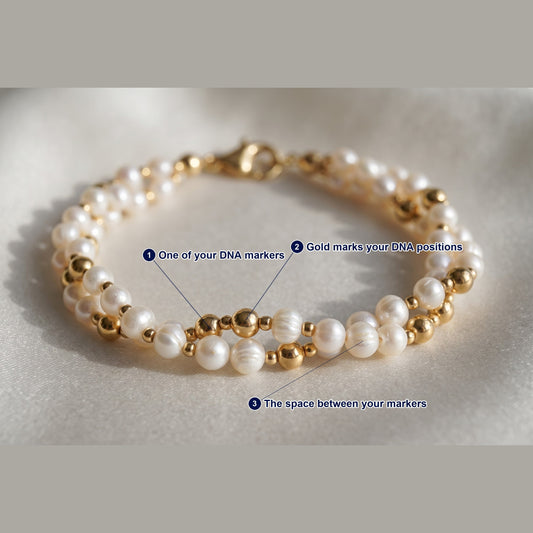
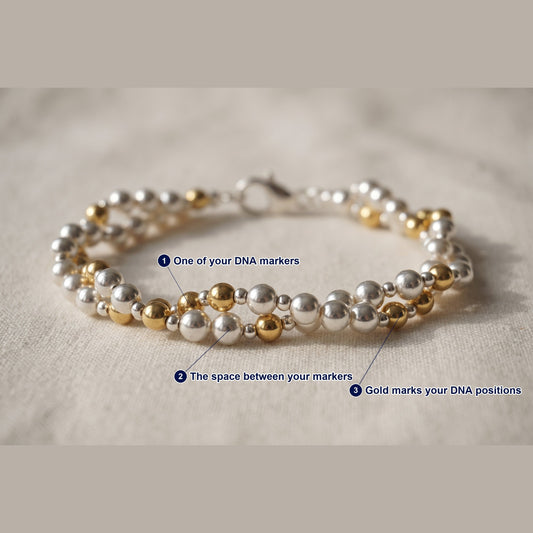
Bracelets start at 179 pounds. The silver clasp and spider styles are 179 pounds, pearl and gold styles are 199 pounds, and the twisted two strand ropes are 229 pounds.
So a bracelet is the more accessible way into the range, and it is not a compromise. The same laboratory reads the same 23 markers either way. The bracelet simply uses less material.
The stones are not identical
Here is a detail worth knowing before you buy, because it surprises people.
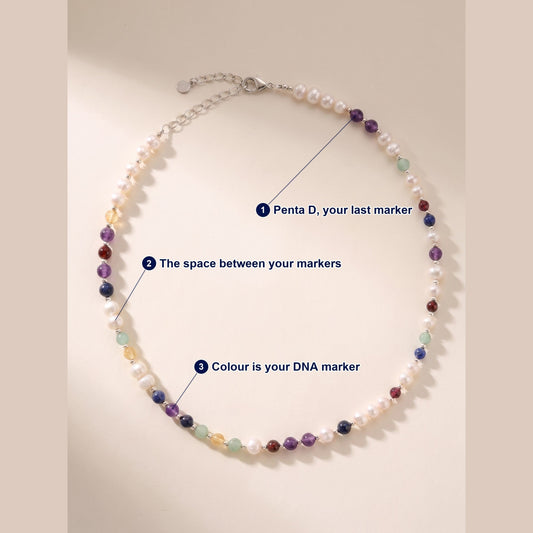
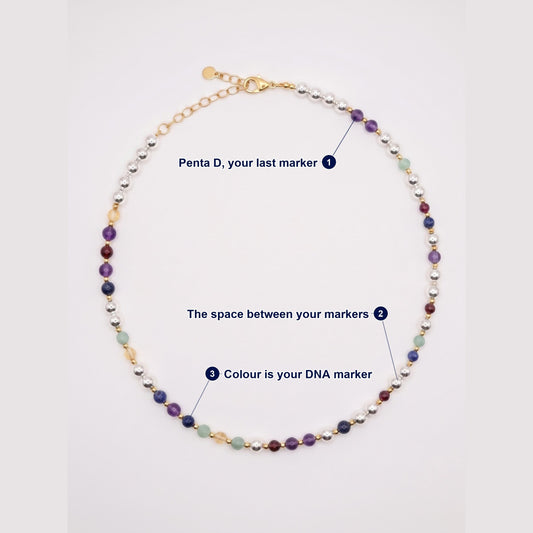
Our necklaces and our twisted bracelets carry the standard palette: Lapis Lazuli blue, Garnet red, Citrine yellow, Amethyst purple and Amazonite green.
Our fine 2mm spider and clasp bracelets carry a different set: Turquoise, Carnelian, Citrine, Amethyst and Amazonite. The turquoise is brighter and the red is warmer, because at 2mm the deeper stones lose their colour and read almost black.
Both palettes echo the coloured fluorescent dyes a laboratory uses to read a DNA profile. Neither is chosen by you, and that is deliberate. Your DNA decides where every marker sits, and the palette stays fixed so the pattern is the only thing that varies.
How they wear
A necklace is a decision. You put it on with an outfit, and you take it off at night.
A bracelet is closer to a wedding ring. Most people put it on and stop thinking about it. Our spider bracelets use a slider, so they pull to whatever size you need, and our clasp bracelets fasten with a lobster clasp and an extension chain. Both are designed to be lived in.
If you are buying for someone who does not usually wear jewellery, the bracelet asks less of them.
Which suits a gift better
For a milestone gift, a graduation, an eighteenth, a retirement, the necklace carries more occasion. It arrives feeling like a significant object, and it photographs well on the day.
For a thank you, a new baby, or a gift to somebody who already owns plenty of jewellery, the bracelet lands better. It is personal without being a statement, and it slots into what they already wear rather than competing with it.
One thing to keep in mind either way. An adult always takes their own swab, with their own consent, so a piece made from an adult's DNA cannot be arranged as a surprise. You can absolutely buy the kit and give it, which is what most people do. For a child, a parent or guardian gives written consent first.
You do not have to choose
If you are buying two pieces at once, the second one is half price automatically, with no code needed. There is a practical reason for that beyond generosity: two pieces ordered together use one kit and one laboratory run, so it costs us less to make them.
That works well for a matching pair, a bracelet for you and a necklace for someone else, or a bracelet and necklace from the same profile worn together.
It only applies within a single order. We delete your marker data after your piece is delivered, so a second piece ordered later needs a fresh kit.
What happens after you order
Identical for both. Your collection kit arrives within 2 to 3 working days. The swab takes about thirty seconds and posts back in the prepaid envelope. Our partner laboratory, with over 25 years in genetic testing, reads your 23 markers, and your piece is made in the UK and delivered 2 to 3 weeks from the day your sample arrives. UK tracked delivery is free.
Frequently Asked Questions
Is a DNA bracelet less personal than a necklace?
No. Both read the same 23 markers from the same swab, and both lay the design out in the order your DNA sets. The bracelet is smaller, not simpler.
Can I get a bracelet and a necklace from the same profile?
Yes, as long as you order them together. One kit covers both, and the second piece is half price. Ordered separately, the second one needs a fresh kit, because we delete your marker data after delivery.
Why do the bracelet stones look different from the necklace stones?
The fine 2mm spider and clasp bracelets use Turquoise and Carnelian where the necklaces use Lapis Lazuli and Garnet. At 2mm the darker stones read as black, so the brighter palette keeps the pattern visible.
Which is better for someone who does not wear much jewellery?
The bracelet. It is easier to live with, needs no thought once it is on, and does not compete with the rest of an outfit.
How long does each take to arrive?
The same. Your kit comes in 2 to 3 working days, and your finished piece follows 2 to 3 weeks after your sample reaches the laboratory.
Your genetic code, profiled from a simple cheek swab and handcrafted into the exact DesigNA necklace. No two are ever the same.
Shop the collection