What Is a DNA Bracelet? How Your Profile Becomes Something You Wear
Share
Search for DNA jewellery and most of what comes back is a double helix charm. A pretty twist of silver, shaped like the diagram from a biology textbook, sold to anyone who wants one.
That is not what this is.
A DesigNA bracelet has no helix on it and no charm hanging from it. The DNA is not the decoration. The DNA is the layout: where every sphere and every stone sits along the strand is decided by a reading taken from your own sample, and by nothing else.
How it actually works
You order a bracelet and a collection kit arrives within 2 to 3 working days.
Inside is a soft swab. You rub it against the inside of your cheek for about thirty seconds, seal it, sign the consent form and post it back in the prepaid envelope. That is your entire involvement, and it takes under a minute.
Our partner laboratory, with over 25 years in genetic testing, then reads 23 identity markers from your sample. These are the same kind of markers used for identity testing generally: highly variable between people, and telling nobody anything about your health, your ancestry or your behaviour.
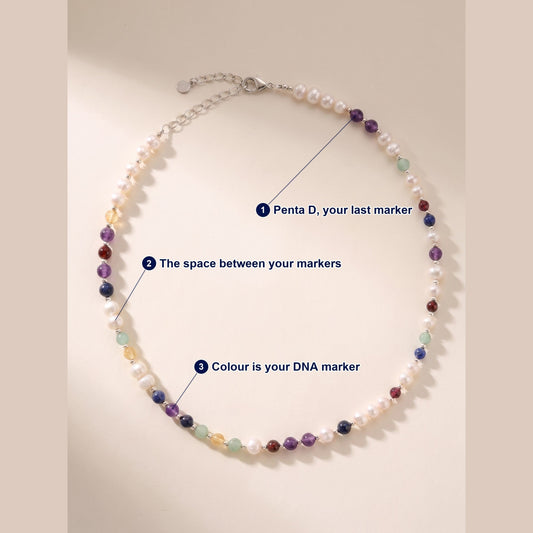
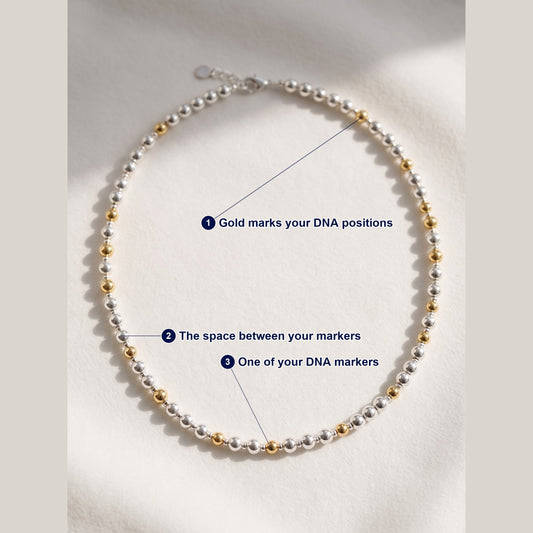
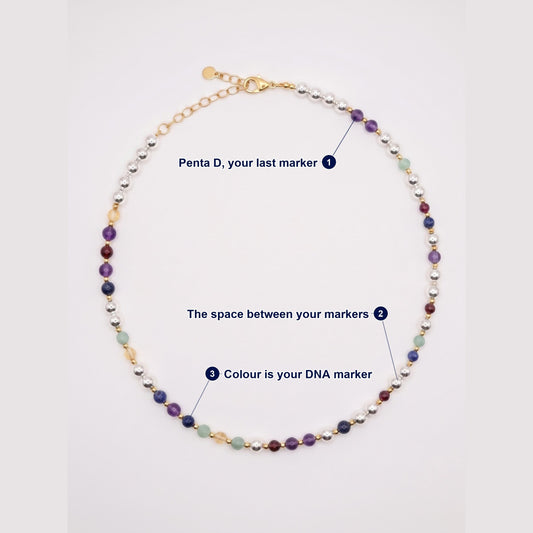
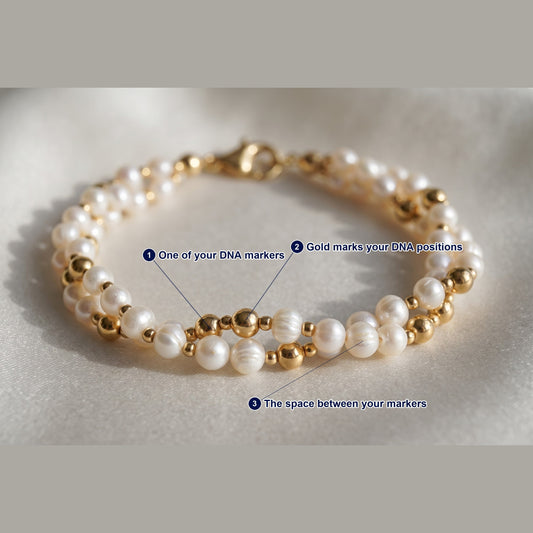
Each marker sits at a position. Those positions become the bracelet. Metal spheres or pearls fill the spaces, and the markers appear along the strand where your profile puts them.
Your bracelet is then assembled by hand in the UK and delivered 2 to 3 weeks after your sample reaches the laboratory.
Why the pattern cannot be repeated
This is the part that separates it from every other personalised bracelet.
A name can be engraved twice. Coordinates can be looked up. A birthstone is shared by everyone born that month. All of those are personal in the sense that they refer to you, but any of them could be reproduced by someone else tomorrow.
Read across 23 markers, a profile is effectively unrepeatable. The odds of another person carrying the same pattern are vanishingly small, with the single exception of an identical twin. So the arrangement on your bracelet is not a design choice we made. It is a fact about you, laid out in silver and stone.
Your certificate of authenticity records the genetic data behind it, which is what makes that claim provable rather than a marketing line.
You do not choose the colours
People expect a customiser and there isn't one, which is deliberate.
The stone palette is fixed. On our fine 2mm spider and clasp bracelets it runs Turquoise, Carnelian, Citrine, Amethyst and Amazonite. On our twisted bracelets it runs Lapis Lazuli, Garnet, Citrine, Amethyst and Amazonite, the same palette as our necklaces.
Both sets echo the coloured fluorescent dyes a laboratory uses to read a DNA profile. Colour is what makes the reading possible in the first place, so it seemed the right place to borrow from.
Because the palette is fixed, the only thing that varies between one bracelet and another is the pattern. Which is the point. If you could rearrange the stones, it would stop being your profile and start being your taste.
Some have no stones at all
Our pattern styles, the ones described as silver and gold or pearl and gold, carry no coloured stones. The markers show as polished gold spheres instead.
You still get exactly the same information. The positions are identical, drawn from the same 23 markers. What changes is that the piece reads as texture rather than colour, which suits people who want something quieter, or who wear a lot of gold already.
The three builds
Spider bracelets are fine, 2mm, and fasten with a slider that adjusts to any wrist. From 179 pounds.
Clasp bracelets are also 2mm, with a lobster clasp and an extension chain. From 179 pounds.
Twisted bracelets are two strands wound into a rope with 5mm spheres, the fullest in the range. 229 pounds.
There is no size to choose. Every style adjusts.
What it is not
It contains no DNA. Your physical sample is used for the reading and is not set into the bracelet, and it is not stored afterwards.
It tells you nothing medical. The 23 markers are identity markers only, and the laboratory never sees or holds anything clinical.
And it cannot be made from somebody else's DNA without them knowing. An adult always takes their own swab and gives their own consent, which means a piece from an adult's profile cannot be arranged as a surprise. You can buy the kit and give it, which is what most people do. For a child, a parent or guardian gives written consent first.
Frequently Asked Questions
Is there actual DNA in the bracelet?
No. Your sample is read in the laboratory and the reading becomes the design. The bracelet holds no biological material, and your sample is not stored after your piece is made.
Can the bracelet tell me anything about my health or ancestry?
No. The 23 markers are used for identity only. They vary a great deal between people but say nothing about health, ancestry or behaviour.
Can I choose the stones or their order?
No. The palette is fixed and the order comes from your profile. If you could rearrange it, it would no longer be a reading of your DNA.
Could someone else end up with the same pattern?
Effectively no, across 23 markers. The one exception is an identical twin, who shares the same profile.
How long does it take?
Your kit arrives in 2 to 3 working days and your finished bracelet follows 2 to 3 weeks after your sample reaches the laboratory. UK tracked delivery is free.
Your genetic code, profiled from a simple cheek swab and handcrafted into the exact DesigNA necklace. No two are ever the same.
Shop the collection