DNA jewellery privacy is the first thing a careful person asks about, and it deserves a careful answer. A DesigNA piece starts with your own DNA. So the question is not whether we take privacy seriously, but exactly what happens at each step. So this post follows the journey in order. It starts at the post box and passes through the laboratory and the jeweller's bench. Finally, it ends with a certificate in a box and nothing left anywhere else.
DNA jewellery privacy starts in the post
The kit arrives in 2 to 3 working days. Inside sit a sterile swab, a consent form and a prepaid envelope. You rub the swab inside your cheek for under two minutes, sign the form, and post the envelope back. That is the only time your DNA travels, and it travels as cells on a swab, not as a profile. Nobody can read DNA by looking at it. A swab in an envelope is useless without a laboratory and your consent form beside it.
The form matters as much as the swab. Genetic data is special category data under UK GDPR, which the ICO explains needs extra protection. So we ask for explicit consent, in writing, before anyone reads anything. An adult always takes their own swab and signs for themselves. A child's piece needs written consent first from a parent or guardian with parental responsibility, and 16 and 17 year olds consent for themselves. The consent page sets out the rules.
What the laboratory reads and then destroys
The envelope goes to Complement Genomics, a UK laboratory with over 25 years in genetic testing. The laboratory extracts the DNA and reads 23 Short Tandem Repeat identity markers. That is the same kind of analysis used for identity and paternity testing in the UK. Each marker has two values, one from each parent. That is the whole reading. It holds nothing about health, ancestry, appearance or traits. The markers sit in stretches of DNA chosen for how they vary, not for what they do.
After profiling, the laboratory destroys the sample. Nothing stays behind, neither swab nor DNA. What leaves the laboratory is a list of 23 markers with their values and fragment sizes, which is a pattern rather than a genome. Our post on what a DNA profile can and cannot say explains why that pattern is safe.
What the jeweller sees
The jeweller never sees your DNA. Our partner in Birmingham's Jewellery Quarter receives the pattern, which is a map of positions and colours. The certificate comes too, so the bench can check the finished strand against it. Every value becomes a stone in the colour of its dye, placed along the strand by fragment size. So the bench works from a drawing, not from a sample. The jeweller strings the piece by hand, checks it against the certificate position by position, and boxes it.
What arrives, and what we delete
The box arrives with the DNA Profile Certificate on top. It carries your name, the certificate number, the date and the table of 23 markers with their values. Keep it in the box, and keep the table of readings out of public photos. The drawing of the strand and the piece itself are yours to show. The readings are genetic data, so treat the paper like a passport.
After the piece arrives, we delete the marker data. We never sell it, share it, or upload it to any database. You can also ask for deletion at any time by emailing sales@mydesigna.co.uk. In short, once the piece is with you, the certificate is the only copy of the reading that exists. Your DNA and privacy sets out the full policy.
The law behind all of this
Two laws sit behind the process. First, the Data Protection Act 2018 and UK GDPR treat genetic data as special category data, which is why the kit asks for explicit consent. Then the Human Tissue Act 2004 makes it an offence to analyse an adult's DNA without their consent. That is why nobody can order a piece from another adult's DNA without them knowing. So the person whose profile goes on the strand always takes the swab and signs the form.
The piece that keeps its secret: the Spider Silver Clasp DNA Profile Bracelet, £179
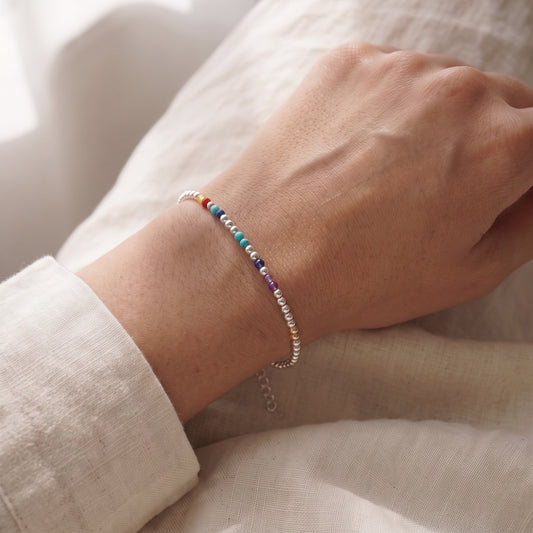
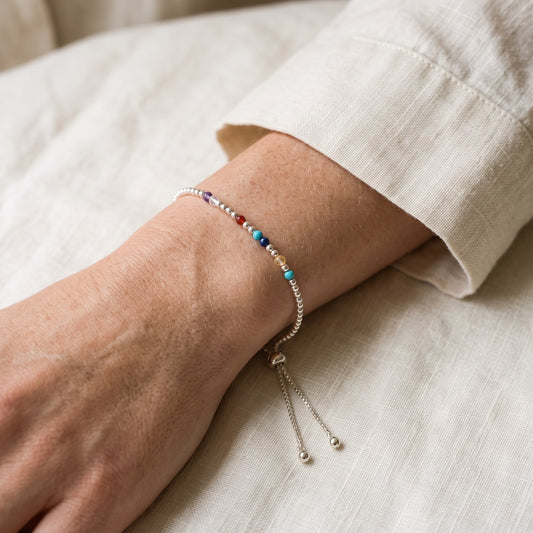
Privacy also shapes which piece people choose. For example, the Spider Silver Clasp DNA Profile Bracelet, £179, is the quietest piece in the range. Fine 2mm spheres in 925 sterling silver sit close to the wrist with 2mm stones in turquoise, carnelian, citrine, amethyst and amazonite. From any distance it passes for a plain silver bracelet. The pattern is there for the wearer, not for the room, and nobody can read anything from it in any case.
The kit arrives in 2 to 3 working days. You take the swab at home, post it back in the prepaid envelope, and the bracelet takes 2 to 3 weeks from the day the laboratory has it. Free UK tracked delivery covers both. For Christmas, order by Sunday 15 November 2026.
Frequently asked questions
Is it safe to post a DNA swab?
Yes. The swab carries cells, not a profile, and nobody can read DNA by looking at it. It travels in a prepaid envelope to a UK laboratory with over 25 years in genetic testing, which destroys the sample after profiling.
Who sees my DNA?
Only the laboratory, and only long enough to read 23 identity markers. The jeweller receives a pattern of positions and colours with no DNA attached. We hold the marker data only until the piece arrives, then delete it.
Does DesigNA keep my profile?
No. The laboratory destroys the sample after profiling, and we delete the marker data after the piece arrives. You can ask for deletion at any time by emailing sales@mydesigna.co.uk.
Can someone order a piece from my DNA without me knowing?
No. An adult always takes their own swab and gives their own consent on the form in the kit. Analysing an adult's DNA without consent is an offence under the Human Tissue Act 2004.
Should I keep the certificate private?
Keep the table of readings out of public photos, because it is genetic data. The drawn strand and the piece itself are yours to share.
Ready for a piece only you can read? Explore the full DesigNA collection.
Your genetic code, profiled from a simple cheek swab and handcrafted into the exact DesigNA necklace. No two are ever the same.
Shop the collection