Do siblings have the same DNA? No. Apart from identical twins, every brother and sister carries their own DNA, because each child inherits a different random half from each parent. Full siblings share, on average, about half of the DNA variation they inherited from the same two parents, and the exact share varies from one pair to the next.
So when the family gathers this Christmas, the people round the table who look most alike still have DNA of their own. This post explains why, in plain words. Then it shows what that means at the 23 markers we read for every DesigNA piece.
Do siblings have the same DNA? The short answer
First, a little context. Every person shares the vast majority of their DNA with every other person. That shared part is what makes us human: the instructions for a heart, two lungs, ten fingers. The interesting part is the small fraction that differs. That variation is what makes you you, and it is the part this question is really about.
Within that variation, full siblings overlap a great deal, because they draw from the same two parents. However, they never draw the same mix. Think of it like two hands dealt from the same two packs of cards. The cards come from the same place, yet each hand turns out different.
There is one exception. Identical twins form when a single fertilised egg splits in two. As a result, they start life with the same DNA. Everyone else, including non identical twins, is a sibling in the ordinary genetic sense.
Why does each child get a different half?
Every person carries two copies of each chromosome, one from their mother and one from their father. When a parent makes an egg or a sperm cell, they pass on only one copy of each. That is where the shuffling begins.
Two things happen. First, the parent's chromosomes sort independently, so each egg or sperm gets a random mix of grandmother's and grandfather's chromosomes. Second, before they separate, matching chromosomes swap stretches of DNA with each other. Scientists call this swapping recombination. It means even a single chromosome passed down is a new blend of two older ones.
Because of these two steps, the half a mother gives her first child is not the half she gives her second. The same is true of the father. For that reason, two children of the same parents end up with related, overlapping, but distinct sets of DNA. If you'd like a refresher on the molecule itself, yourgenome.org explains what DNA is clearly.
How much DNA do siblings actually share?
On average, full siblings share about 50 percent of the DNA they inherited from their parents. That figure is an average, though, not a rule. Because the shuffle is random, some sibling pairs share a little more and some a little less.
Here's how the main family relationships compare, in simple terms:
- Identical twins share essentially all of their DNA.
- Non identical twins share about half on average, just like any brother and sister born years apart.
- Full siblings share about half on average, with real variation between pairs.
- Half siblings share one parent, so they share about a quarter on average.
Notice that non identical twins sit with ordinary siblings. Being born on the same day changes nothing about how the DNA was dealt.
What does this look like at the 23 markers we read?
A DesigNA piece starts with an identity profile. Rather than reading your whole genome, the laboratory reads 23 short tandem repeat markers, often shortened to STR markers. Each one is a short stretch of DNA where a tiny sequence repeats over and over. The number of repeats differs from person to person, and that is what the profile records. Our post on why the laboratory reads 23 markers covers the reasoning in more depth.
At every marker, you carry two versions, called alleles. One came from your mother and one from your father. That is why the certificate lists two readings for each marker.
Now apply the shuffle. For any single marker, each parent hands one of their two alleles to each child, at random. So two siblings might inherit the same allele from both parents at one marker. At the next, they might match on one allele only. At another, they might share neither. Across 23 markers, that patchwork adds up to a profile that clearly belongs to its owner, and to nobody else.
Will two siblings' DesigNA pieces look the same?
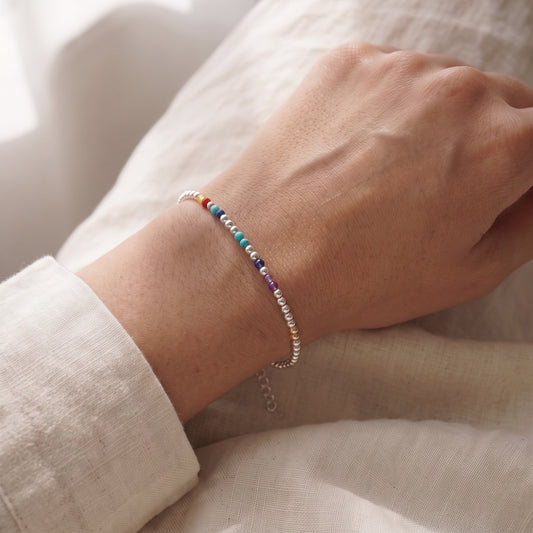
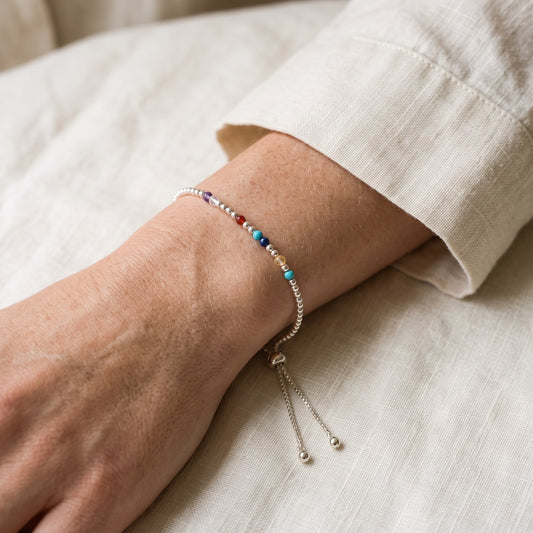
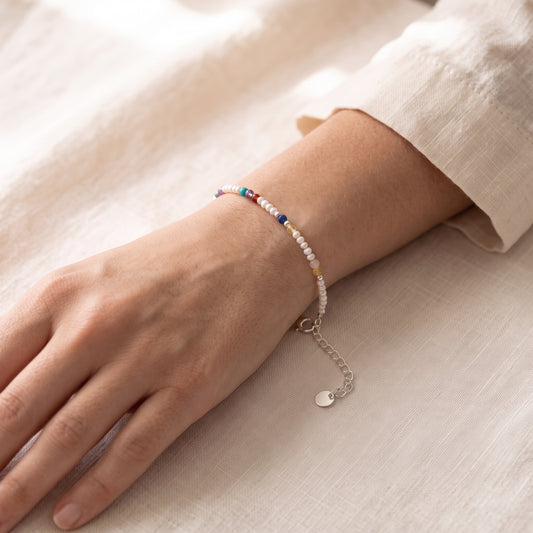
No, and this is the part we find quietly fascinating. On a DesigNA piece, each reading becomes a stone, and its position along the strand comes from the size of the DNA fragment the laboratory measured. In other words, the same allele always lands in the same place.
So if a brother and sister both inherited the same allele at a marker, a stone sits in the same spot on both pieces. Where they inherited different alleles, the stones fall in different places. Lay two siblings' pieces side by side and you may notice familiar moments along the strand, mixed with stretches that are entirely their own. Both pieces still finish on the purple amethyst, because the last marker on every piece is Penta D, which always takes the purple stone. Its readings, and the positions of the stones before it, are where the differences show.
Identical twins are the one case where two pieces would match, because they share the same profile. We explain that in our post on identical twins and DNA jewellery.
What a sibling's piece can't tell you
It's worth being clear about the limits. A DesigNA piece is jewellery made from an identity profile. It doesn't prove anything about how two people are related, and we never read it that way. Many people share the same allele at a given marker simply because that allele is common. So a matching stone between two pieces is a lovely detail to notice, not evidence of anything.
Equally, the 23 markers say nothing about health, ancestry, traits or personality. They exist to tell one person from another, and that is all we use them for. Our guide to what a DNA profile can and cannot say sets this out in full.
Pieces for brothers and sisters this Christmas
Comparing pieces is part of the fun at a family gathering. Each one is personal and precise, and no two are alike. Yet worn together, they belong to the same story.
Every sibling takes their own cheek swab and signs their own consent form. The UK Human Tissue Act 2004 makes it an offence to analyse someone's DNA without their consent, so a surprise sample is never an option. For a child's piece, a parent gives written consent first. Our post on mother and daughter DNA jewellery shows how matching pieces work, and the same approach works for brothers and sisters.
On timing, the order date for a finished piece by Christmas was Sunday 15 November 2026, and it has passed. Wrap the kit instead: each sibling opens it on Christmas Day, takes their own swab, and their piece follows 2 to 3 weeks after the laboratory receives it. You can see every necklace and bracelet in the full DesigNA collection.
Frequently asked questions
Do siblings have the same DNA?
No, unless they are identical twins. Full siblings share about half of the DNA they inherited from their parents on average, but each child receives a different random half from each parent. As a result, every sibling has DNA of their own.
Do non identical twins have the same DNA?
No. Non identical twins come from two separate eggs, so genetically they are ordinary siblings who happen to share a birthday. On average, they share about half of their inherited DNA, just like any brother and sister.
Do half siblings share DNA?
Yes, but less. Half siblings share one parent rather than two, so on average they share about a quarter of their inherited DNA. The exact amount varies from pair to pair.
Would two siblings get the same DesigNA piece?
No. Siblings often match at some of the 23 markers and differ at others, so their pieces may share stones in a few places but are never the same. Only identical twins would produce the same profile, and therefore the same design.
Can a DesigNA piece show that two people are related?
No. A DesigNA piece is jewellery made from an identity profile, and we never use it to say anything about relationships. Matching stones on two pieces are a detail to enjoy, not evidence of anything.
Your genetic code, profiled from a simple cheek swab and handcrafted into the exact DesigNA necklace. No two are ever the same.
Shop the collection