Every DesigNA piece starts with a question people rarely ask out loud. Why does the laboratory read 23 DNA profiling markers, when your genome runs to billions of letters? The short answer is that identity testing never needed the whole book. It needs a handful of pages where people differ most. So this post explains what those markers are, why 23 of them prove who you are, and how each one turns into a stone on the strand.
What a Short Tandem Repeat actually is
Your DNA is a long sequence of four chemical letters, A, C, G and T. Most of that sequence looks the same from one person to the next. However, at certain points a short block of letters repeats itself, over and over, like a stutter. Scientists call each of these blocks a Short Tandem Repeat, or STR, and Wellcome's yourgenome site explains them well.
The key point is simple. The number of repeats at a given spot varies between people. For example, you might carry nine repeats at one marker while your neighbour carries twelve. Neither count means anything on its own. Instead, the pattern of counts across many markers becomes a signature, because the odds of two unrelated people matching at every one are vanishingly small.
Why DNA profiling markers come as a small fixed set
A laboratory could, in theory, read your entire genome. For identity work it does not, for three reasons. First, a fixed set of markers takes far less time and money to read. Second, laboratories read named markers, so a profile means the same thing wherever a laboratory reads it. Third, a profile built from repeat counts tells you who, and never what.
The UK laboratory DesigNA works with, Complement Genomics, reads 23 of these markers. It has over 25 years in genetic testing, and it uses the same kind of analysis as identity and paternity testing in the UK. The marker set includes well known loci such as TH01, vWA, FGA, CSF1PO, D3S1358, D16S539 and Penta D. NIST's STRBase holds the reference data for markers like these, so anyone can look them up.
Each marker carries two values, because you inherit one copy from each parent. So 23 markers give 46 numbers, and those 46 numbers are your profile.
Who you are, never what you are
This is the part people find reassuring. The profile is a list of repeat counts at identity markers, nothing more. It says nothing about your health, your ancestry, your appearance or any trait. In short, it is the same information a court uses to say who, never what.
That matters for jewellery. A DesigNA piece carries the pattern of your profile, not your DNA itself. The laboratory destroys the swab sample once it has read the markers, and we delete the marker data after your piece arrives. You can read the full policy on our DNA and privacy page.
From 46 numbers to about 30 stones
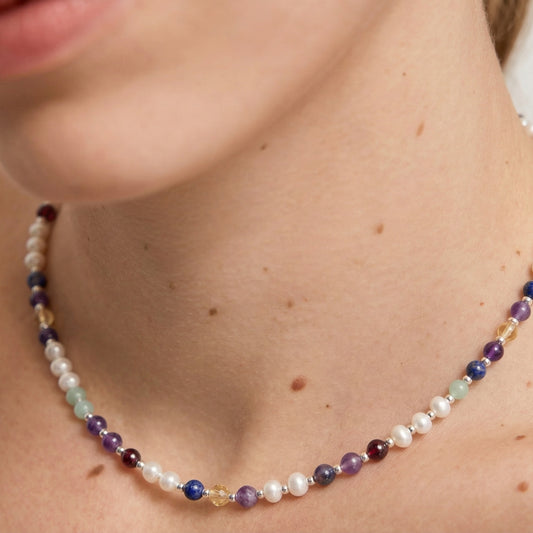
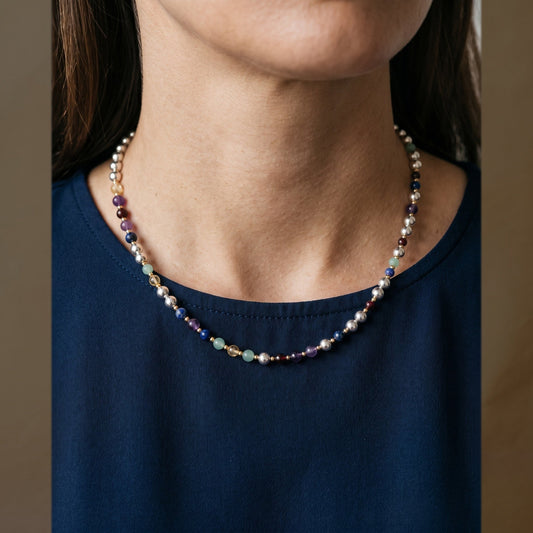
Here is how the reading becomes a necklace. The machine reads the markers by capillary electrophoresis, with each marker tagged in one of five fluorescent dye colours so it can tell them apart. Every value then becomes a stone in that dye's colour: lapis lazuli for blue, amazonite for green, citrine for yellow, garnet for red and amethyst for purple.
Position follows fragment size, measured in base pairs, from the smallest fragment to the largest. So the order of the stones is not a design choice. Your DNA sets it. Across 23 markers with two values each, that comes to about 30 stone positions along the strand. Between them, polished silver spheres, batons or pearls hold the spaces, and a small spacer sits either side of each stone.
Every piece then ships with a signed DNA Profile Certificate. It lists all 23 markers with the dye channel, the two values and the fragment sizes, and it draws the strand so you can see exactly where each marker sits. For the full walk through, read how DesigNA works.
The piece that shows it best: the Silver DNA Profile Necklace
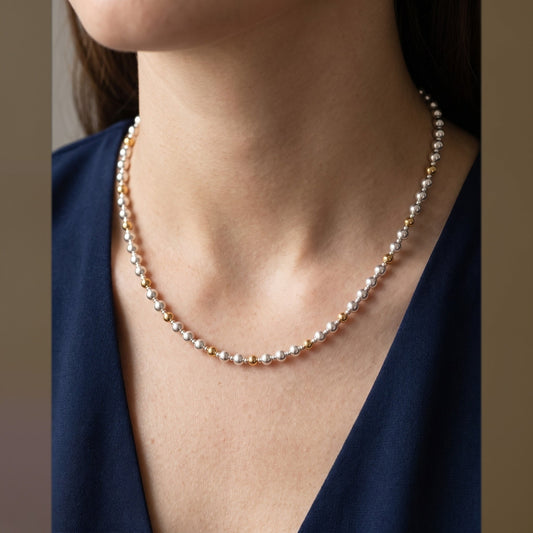
If you want to see 23 markers at their clearest, start with the Silver DNA Profile Necklace, £249. The stones sit along 925 hallmarked sterling silver batons, with a silver spacer either side of each one, so every colour reads cleanly against the metal. It comes in 16, 18 or 20 inches, each with a 2 inch extender. A silver clasp closes one end, and the extender chain finishes in a small stamped 925 disc at the other.
Order it and the swab kit arrives in 2 to 3 working days. Take the swab at home, post it back in the prepaid envelope, and the laboratory reads your 23 markers. Then our partner jeweller in Birmingham's Jewellery Quarter strings the piece by hand, in 2 to 3 weeks from the day the laboratory has your swab. Free UK tracked delivery covers both the kit and the finished necklace.
Frequently asked questions
What are DNA profiling markers?
They are short stretches of DNA where a block of letters repeats a variable number of times. Scientists call them Short Tandem Repeats, or STRs. The number of repeats differs between people, so a set of them works as a signature.
Why 23 markers and not more?
Because 23 named markers, each with two values, already separate one person from another with enormous confidence. Reading more would not change who you are. The kit our laboratory uses fixes the set, so every customer gets the same 23.
Can the profile reveal anything about my health?
No. The profile is a list of repeat counts at identity markers, and it says nothing about health, ancestry, appearance or disease. It is the same thing a court uses to say who, never what.
Does my necklace contain my DNA?
No. It carries the pattern of your profile as coloured stones, in the exact order your DNA places them. The laboratory destroys the sample after profiling, and we delete the marker data after your piece arrives.
Which piece shows the markers most clearly?
The Silver DNA Profile Necklace, £249. Its 925 sterling silver batons and spacers give every stone a clear setting, so the pattern reads clearly along the strand.
Ready to see your own 23 markers as a strand? Explore the full DesigNA collection.
Your genetic code, profiled from a simple cheek swab and handcrafted into the exact DesigNA necklace. No two are ever the same.
Shop the collection