Lapis lazuli jewellery has a pull that few other stones can match. The blue runs deep and opaque, flecked with gold coloured pyrite, and people have treasured it for thousands of years. On a DesigNA piece, though, lapis does more than look beautiful. It also has a job. Every value your DNA profile returns in the blue dye channel becomes a lapis lazuli stone on your strand. So this post covers the stone itself, what tradition says about it, and exactly what it marks on your piece.
A stone that ancient Egypt prized
Few stones carry as much history as lapis. Ancient Egypt prized it, and painters later ground it into ultramarine, a deep blue pigment.
In fact, lapis lazuli is a rock rather than a single mineral. Its colour comes mainly from lazurite, and the flecks of gold are pyrite, as geology.com's guide to lapis lazuli explains. Because it is a rock, the mix varies from stone to stone, so no two lapis stones look quite the same.
Ours is also natural, never lab grown or imitation, and it comes from established UK suppliers.
What lapis means
Tradition links lapis with honest self expression. So people have long worn it as a stone for speaking plainly and saying what they mean. We share that as a belief, not a fact, because a stone cannot change what you say. However, it suits a piece that is, quite literally, a statement of who you are.
Lapis lazuli jewellery with a job to do
Here is where a DesigNA piece differs from any other lapis lazuli jewellery. The stone is not decoration. It is a marker, and your DNA decides where it goes.
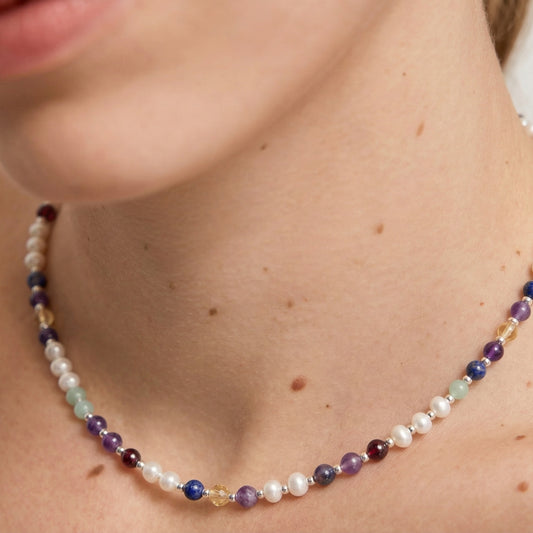
First, a UK laboratory with over 25 years in genetic testing reads 23 identity markers from your cheek swab. The machine tags those markers in five fluorescent dye colours so it can tell them apart: blue, green, yellow, red and purple. Each marker has two values, because you inherit one from each parent. Then every value becomes a stone in that dye's colour, placed along the strand by fragment size, from the smallest to the largest. The science page walks through the process.
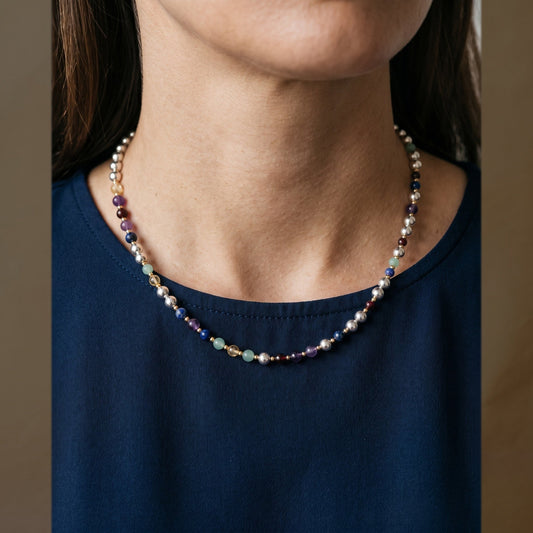
So every value the machine reads in the blue dye channel becomes a lapis lazuli stone. Which markers sit in the blue channel also depends on the kit our laboratory uses. How many blue stones you have, and where they fall, follows your own profile, and nobody else has that pattern. The semi precious stones page shows the full palette.
The certificate in your box then shows where each lapis sits, with its position number and a key of the stone colours, so you can read the strand against your profile. For example, two sisters would both have lapis on their strands, but the count and the spacing would differ, because siblings share only about half their values. Identical twins, on the other hand, share a profile, so their pieces would match.
Which pieces carry lapis
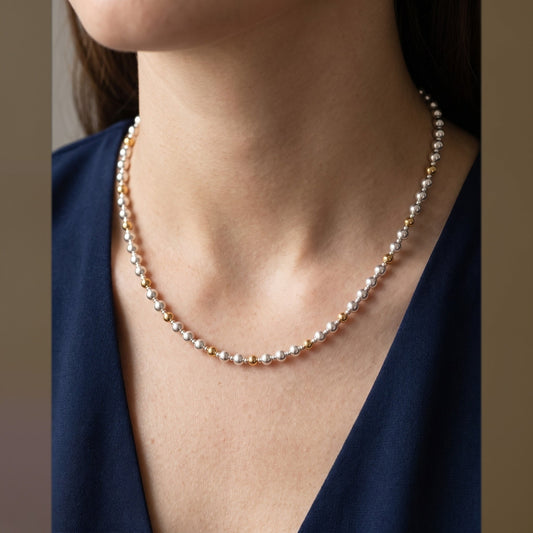
Necklaces and twisted bracelets carry 4mm lapis lazuli, with a 925 silver spacer either side of each stone on the silver pieces. The fine 2mm spider and clasp bracelets use turquoise in the blue role instead. Pattern and "and gold" pieces, though, carry no stones at all. On those, a gold filled sphere sits at every marker position and the identity lives in the positions.
Finally, care is simple. Clean lapis with warm water and a soft cloth, and never use an ultrasonic cleaner. Then store the piece flat in its box when you take it off. Every DesigNA piece carries a six month warranty, and the jewellery care page has the full guide.
The Twisted Silver DNA Profile Bracelet
If you want lapis at its best on the wrist, start with the Twisted Silver DNA Profile Bracelet, £229. Two strands of polished 5mm 925 sterling silver spheres wind into a rope, and your markers sit along it as 4mm natural stones: lapis lazuli for every blue dye value, with garnet, citrine, amethyst and amazonite for the rest. Then a single lobster clasp and extender chain finish it, with the oval DesigNA tag in silver at the clasp end. It arrives in the black DesigNA box with your signed certificate on top, free by UK tracked post, and we make it in 2 to 3 weeks from the day the laboratory has your swab.
Frequently asked questions
Is lapis lazuli a real gemstone?
Yes. Lapis lazuli is a natural rock, mostly lazurite with flecks of pyrite, and ours comes from established UK suppliers. Also, we never use lab grown or imitation stones.
How many lapis stones will my piece have?
That depends on your DNA. Every value the machine reads in the blue dye channel becomes a lapis stone, so the number and the positions follow your own profile. Two pieces only match when the DNA matches, such as identical twins.
Do the bracelets use lapis too?
The twisted bracelets do, at 4mm, because they use the same palette as the necklaces. The fine 2mm spider and clasp bracelets use turquoise in the blue role instead, with carnelian for red.
Can I choose lapis for every stone?
No. The palette stays the same for everyone, and every marker appears in its dye colour in the exact order your DNA places it. In short, that order is what makes the piece one of one.
How do I clean lapis lazuli jewellery?
Warm water and a soft cloth. Avoid ultrasonic cleaners, and store the piece flat in its box between wears.
Ready to see where your blue stones fall? Explore the full DesigNA collection.
Your genetic code, profiled from a simple cheek swab and handcrafted into the exact DesigNA necklace. No two are ever the same.
Shop the collection