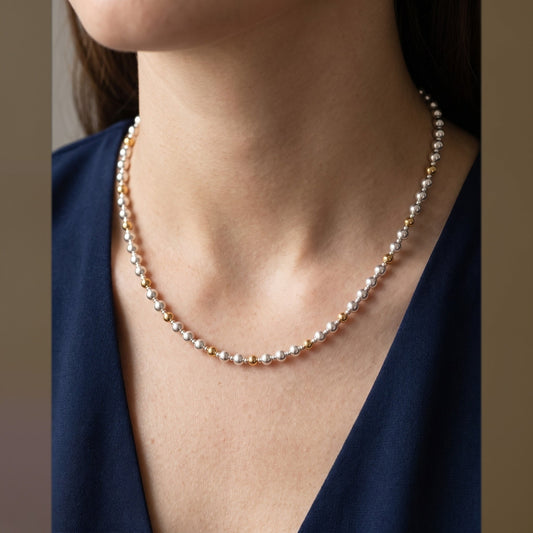
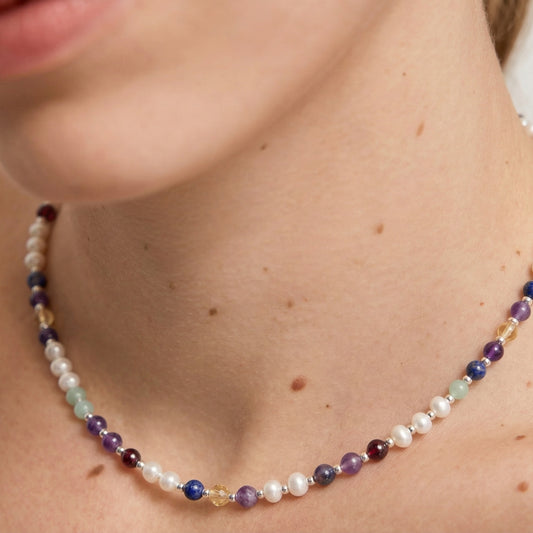
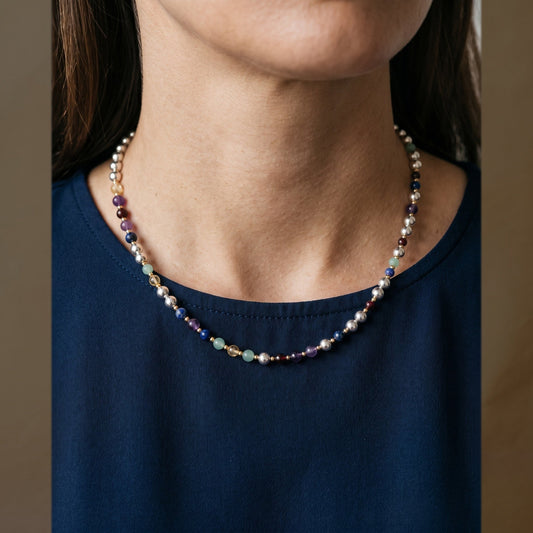
Every DesigNA piece starts in a laboratory and finishes on a jeweller's bench. The profile leaves the laboratory as a pattern, a list of 23 markers in the order fragment size places them. Then a partner jeweller turns that pattern into a strand. We make every piece in the UK, as handmade jewellery from Birmingham's Jewellery Quarter. So this post follows one strand from the first sphere to the final check against the certificate.
Why handmade jewellery from Birmingham's Jewellery Quarter
The Jewellery Quarter is a historic district of working jewellers in the centre of Birmingham. It also has its own Assay Office. The Birmingham Assay Office tests and hallmarks precious metal. That matters to us, because our silver pieces use 925 hallmarked sterling silver and the Gold DNA Profile Necklace uses 9ct hallmarked gold. Sterling silver is 92.5 percent silver, and the Hallmarking Act 1973 requires a hallmark on gold and silver above set weights. So the bench, the metal and the mark all sit in one district.
One point of honesty. The Jewellery Quarter address belongs to our partner jeweller, not to DesigNA. We are a Durham company, and we send the pattern to Birmingham because that is where the skill lives.
What arrives at the bench
The jeweller never sees your DNA. The laboratory, a UK laboratory with over 25 years in genetic testing, destroys the sample after profiling. What arrives instead is the pattern. It lists 23 markers, each with two values, so about 30 stone positions, every one numbered and matched to a dye colour. Each dye has one stone. On necklaces and twisted bracelets that means lapis lazuli for blue, garnet for red, citrine for yellow, amethyst for purple and amazonite for green. How DesigNA works explains how the laboratory builds that pattern.
The jeweller also receives the certificate. It carries the drawn strand with every position numbered, so the bench works from the same map you will open in the box.
Strung by hand, no needle
Stringing starts at the extender end and runs towards the clasp. First, the jeweller feeds the thread by hand through the opening run of silver. There is no needle. Then the pattern takes over. A sphere, a spacer, the stone, a spacer, and the next sphere, in the order the markers decide. A 925 silver spacer sits either side of each stone, and the spheres hold the spaces between.
Because position follows fragment size, and the kit fixes which markers it reads, the first stone is almost always D2S441 in the yellow citrine. The last stone on every DesigNA piece is Penta D, always in amethyst, at the clasp end. In other words, the jeweller strings towards a purple stone every single time. Only the values in between change, and those belong to the wearer alone.
Finishing the strand
Once the final amethyst is on, the jeweller fits the findings. There is one lobster clasp, one extender chain, and one small stamped 925 disc on the end of that extender. Never two of anything. The oval DesigNA tag sits at the clasp end, silver on silver pieces and gold on gold pieces. Necklaces come in 16, 18 or 20 inches, each with a 2 inch extender. Twisted bracelets take two strands and wind them into a rope.
Next comes the check. The jeweller lays the finished strand beside the certificate and reads it position by position. Every stone has to match the dye colour in the drawn pattern, and every number has to sit in the right place. Only after that does the piece go into the black jewellery box. Then comes the navy sleeve, then the matte black outer box with the certificate on top. Finally, it ships with free UK tracked delivery.
Why hand stringing matters for a one of one piece
A machine could string a template, but no DesigNA pattern repeats. Every strand follows a different profile, so every strand is a different job. Hand stringing lets the jeweller follow the map rather than a mould. It also means a person checks the piece against the certificate before it leaves, which is the step that makes the certificate worth having. In short, the certificate is a promise, and the check in the Jewellery Quarter is where we keep it.
The Twisted Silver DNA Profile Bracelet, £229
The Twisted Silver DNA Profile Bracelet, £229, shows this work at its most demanding. Two strands of 925 sterling silver, strung by hand and then wound together into a rope. The 5mm silver spheres carry the run, and 4mm stones in lapis, garnet, citrine, amethyst and amazonite mark the profile. A single silver clasp and extender close it, with the oval tag at the clasp end. So it is handmade jewellery from Birmingham's Jewellery Quarter in the fullest sense, built by hand from a pattern that exists once.
Frequently asked questions
Where does DesigNA make its jewellery?
In the UK. A partner jeweller in Birmingham's Jewellery Quarter strings and finishes every necklace and bracelet by hand. The laboratory work also happens in the UK, and the finished piece ships with free tracked delivery.
Is the Jewellery Quarter address DesigNA's own?
No. That address belongs to our partner jeweller. DesigNA is the trading name of Double Strand Ltd, founded in Durham in 2025. Its registered office sits inside the Durham Genome Centre in Lanchester, County Durham.
Does the jeweller see my DNA?
No. The jeweller receives a pattern of positions and colours, nothing more. The laboratory destroys the sample after profiling, and we delete the marker data after your piece arrives.
How does the jeweller know the order is right?
The certificate carries a drawn strand with every position numbered. After stringing, the jeweller checks the finished piece against it, stone by stone, before it ships.
How long does the making take?
The kit arrives in 2 to 3 working days. Then the piece takes 2 to 3 weeks from the day the laboratory has your swab. That includes the stringing and the check in the Jewellery Quarter.
Ready to see the rest of the range? Explore the full DesigNA collection.
Your genetic code, profiled from a simple cheek swab and handcrafted into the exact DesigNA necklace. No two are ever the same.
Shop the collection