Silver spacers are the smallest parts of a DesigNA necklace and the easiest to overlook. Look closely at any stone on the strand and you find a thin ring of 925 silver on each side of it. It sits between the stone and the sphere or baton beyond. There are two per stone, always, and on the gold pieces they use gold filled metal. People ask whether they carry part of the reading. They do not. So this post explains what the spacers do and why the jeweller never strings a stone without them. It also shows how they fit into the order of the strand.
What silver spacers are
A spacer is a small ring of metal, 925 hallmarked sterling silver on our silver pieces, with a hole through the centre for the thread. Sterling silver is 92.5 percent silver, and the Hallmarking Act 1973 requires a hallmark on silver above set weights. So the spacers belong to the same hallmarked metal as the rest of the strand. On the "and gold" and pattern pieces, and on the Gold DNA Profile Necklace, the spacers use gold filled metal. That is a thick layer of gold bonded to a base metal core, far thicker than plating.
However, the spacers are not markers. Every value the laboratory reads becomes a stone, and the stones carry the profile. The spheres, batons or pearls hold the spaces between, as how DesigNA works explains. Instead, the spacers sit in a third category. They belong to the stone, one on each side, and they travel with it wherever the fragment size places it.
Why there are always two
First, the spacers protect the stone. A 4mm stone sitting directly against a 5mm sphere or a long baton would rub at its edges every time the strand moved. Instead, a spacer on each side gives the stone a seat and keeps metal against metal rather than metal against stone. Second, the spacers frame the stone. A thin ring of bright silver either side lifts the colour. So a dark lapis or a deep garnet reads clearly against the metal instead of sinking into it.
Third, the spacers keep the reading legible. Because every stone wears the same pair, the eye learns the rhythm. Sphere, spacer, stone, spacer, sphere. Wherever the pattern puts a stone, the same frame announces it. That consistency is what lets you run a finger along the strand and count markers against the certificate. Our post on what the DNA profile certificate shows explains how that check works.
How the spacers fit into the stringing
Our partner jeweller in Birmingham's Jewellery Quarter strings every strand by hand, with no needle, from the extender chain towards the clasp. The pattern from the laboratory lists the positions, and the jeweller follows it. So the sequence at every marker is the same. A sphere or baton, then a spacer, then the stone, then a spacer, then the next sphere. The spacers never change the position of a stone. The pattern sets the position, and the spacers simply sit either side of it.
Because the kit fixes the markers, the first stone is almost always D2S441 in citrine. The last is always Penta D in amethyst at the clasp end. Both wear their two spacers like every other stone. Read strung by hand in the Jewellery Quarter for the whole process at the bench.
Where the spacers differ across the range
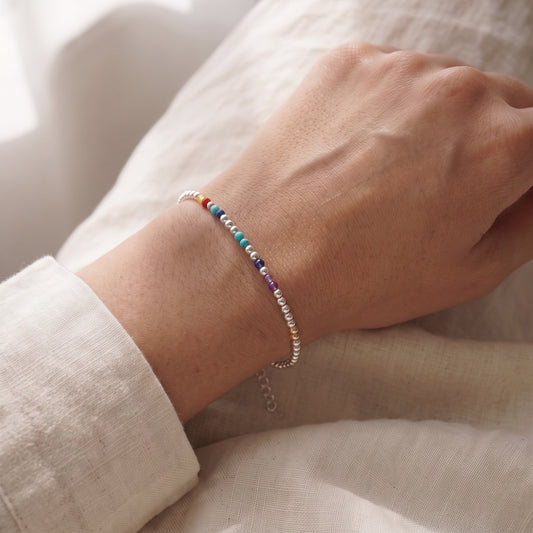
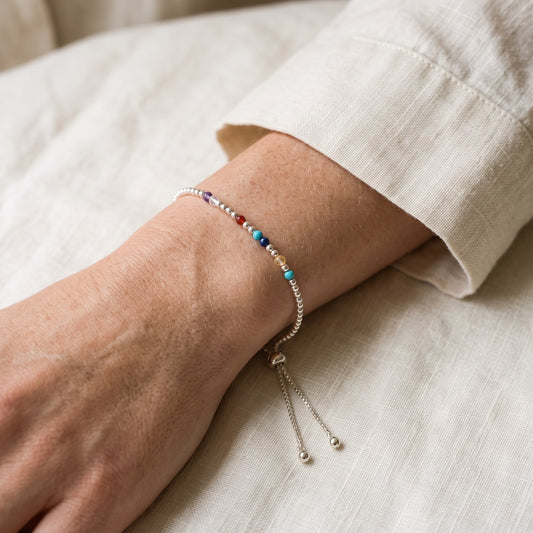
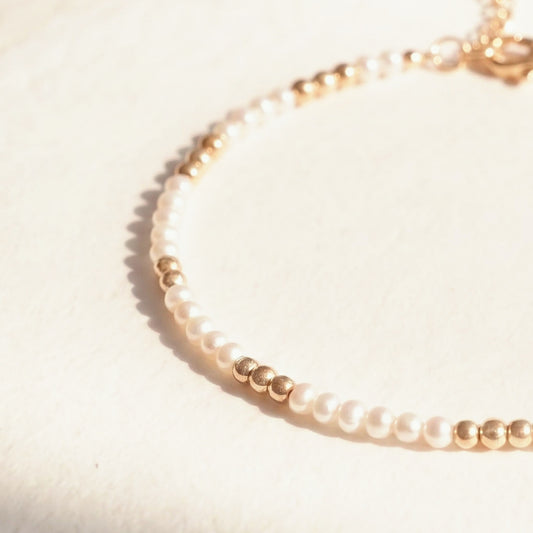
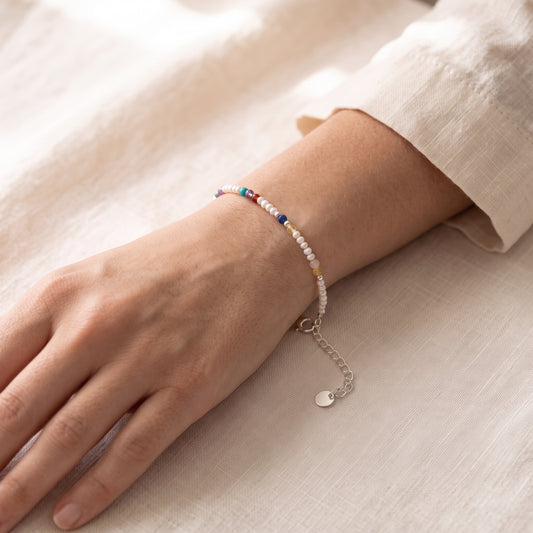
On the Silver DNA Profile Necklace, the spacers sit between the stones and polished silver batons. On the Silver Sphere necklaces, they sit between stones and 5mm spheres. Then, on the Silver Sphere Gold Accent, gold filled accents take their place beside every stone. Also, on the Pearl DNA Profile Necklace, a silver spacer sits either side of each stone between the pearls. The twisted bracelets use spacers too. In fact, the twisted pearl rope is the only pearl bracelet with metal spacers beside the stones.
However, the fine 2mm bracelets are the exception. On the pearl versions there are no metal spheres between the pearls and the stones at all. So the strand reads as pearl and colour alone. Our post on the DNA bracelet range compares the fittings. On pattern pieces, a gold filled sphere replaces each stone, and gold filled spacers still sit either side. So the rhythm of the strand holds even without colour.
The piece that shows the spacers best: the Silver DNA Profile Necklace, £249
The Silver DNA Profile Necklace, £249, makes the spacers easiest to see. Long polished batons in 925 hallmarked sterling silver run between the stones. So each stone sits in a clear frame of baton, spacer, stone, spacer, baton. Lapis lazuli, garnet, citrine, amethyst and amazonite mark every value, placed by fragment size. Choose 16, 18 or 20 inches, each with a 2 inch extender. It closes with a silver clasp and the oval DesigNA tag, with the stamped 925 disc on the extender. Necklaces start at £249.
The kit arrives in 2 to 3 working days. The wearer takes their own cheek swab at home and posts it back in the prepaid envelope. Then the necklace takes 2 to 3 weeks from the day the laboratory has the swab. Free UK tracked delivery covers both.
Frequently asked questions
What are the silver spacers for?
They protect each stone from rubbing against the metal beside it, and they frame the colour so it reads clearly. They also keep the rhythm of the strand consistent, so you can count markers against the certificate.
Do the spacers carry part of my profile?
No. The stones carry the profile, one per value. The spacers belong to the stone and sit either side of it wherever the pattern places it.
Are the spacers silver on every piece?
On the silver and pearl necklaces and the twisted bracelets, they are 925 hallmarked sterling silver. Then, on the gold, "and gold" and pattern pieces, they use gold filled metal. Finally, on the Silver Sphere Gold Accent necklace, gold filled accents take their place.
Do the fine bracelets have spacers?
The fine 2mm pearl bracelets have no metal between the pearls and the stones. The twisted pearl rope is the only pearl bracelet with metal spacers beside the stones.
Can a stone be strung without spacers?
Not on a DesigNA piece. The jeweller strings every stone with a spacer on each side, so the frame is the same at every marker.
Ready to see the frame around every stone? Explore the full DesigNA collection.
Your genetic code, profiled from a simple cheek swab and handcrafted into the exact DesigNA necklace. No two are ever the same.
Shop the collection