Open a DesigNA box and the first thing you see is paper, not jewellery. The DNA profile certificate sits on top, A4 and signed, and it explains the piece beneath it before you lift that piece out. Most jewellery arrives with a receipt. This arrives with a reading. So this post walks down the certificate line by line, from the number at the top to the signature at the bottom. It also says why each part is there.
Why the DNA profile certificate exists
A DesigNA necklace or bracelet is a reading of a real profile, and the certificate proves it. Without the certificate, a strand of coloured stones is a decoration about DNA, pretty but unprovable. With it, every stone on the strand has a line in a table. That line says which marker the stone stands for, which value it carries and where it sits. In short, the certificate is what separates the piece from a necklace with a name on it.
The certificate is also honest about what it is. It is decorative and has no legal standing. It is not a paternity report or an identity document, and nobody can use it as one. Instead, it records the pattern the laboratory read, so that you can see your piece is true to that pattern.
The top of the page: number, name and date
First comes the certificate number. Every certificate carries its own, and it ties the paper to one piece and one profile. Next comes the holder's name, the person whose cheek swab produced the profile, and then the date. Because an adult always takes their own swab, the name on the certificate is the name of the person who consented. For a document that holds genetic data, that matters.
The table of 23 markers
The heart of the certificate is a table with 23 rows, one for each marker. A marker, in this sense, is a Short Tandem Repeat, a short stretch of DNA that repeats a different number of times in different people. NIST STRBase is the reference database for these markers, and the same kind of analysis underpins identity and paternity testing in the UK.
Each row shows four things. The marker name comes first, such as TH01, vWA, FGA, CSF1PO or Penta D. Next comes the dye channel. The laboratory tags the markers in five fluorescent dye colours, blue, green, yellow, red and purple, so the machine can tell them apart. Then come the two values, one from each parent. Finally, the row gives the fragment size for each value, measured in base pairs.
That last column decides the design. The laboratory reads the markers by capillary electrophoresis. The fragment size is what places each value along the strand, from the smallest to the largest. So the table is not just a record. It is the instruction the jeweller follows when stringing the piece. The science explains the method in more detail.
The drawn strand and the stone key
Below the table sits a drawing of the strand itself. Every position carries a number, so you can run a finger along the real piece and find the matching stone on the page. The drawing also shows two kit facts that hold for every DesigNA piece. First, the opening stone is almost always D2S441 in the yellow stone. Second, the final stone is always Penta D in amethyst, at the clasp end. Only the values in between belong to you alone.
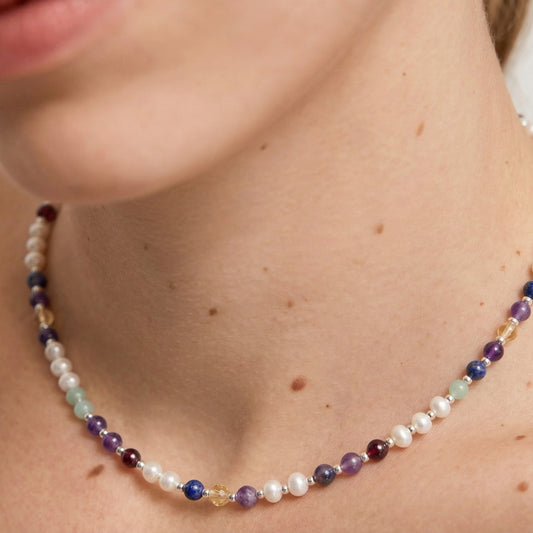
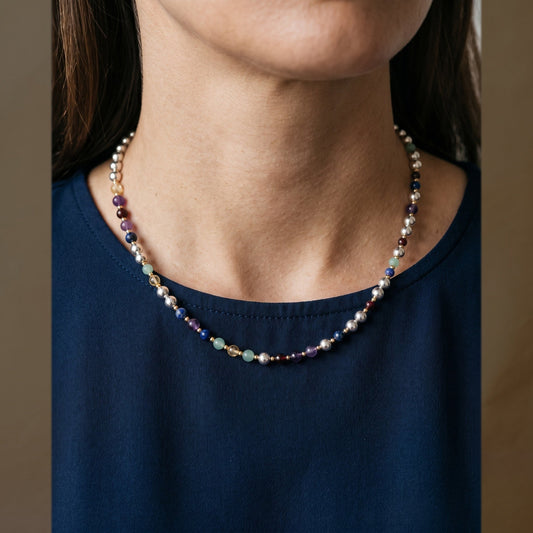
Next to the drawing sits the stone key, which names the stone for each dye colour. On necklaces and twisted bracelets that means lapis lazuli for blue, garnet for red, citrine for yellow, amethyst for purple and amazonite for green. On the fine 2mm bracelets, turquoise takes blue and carnelian takes red. Pattern and "and gold" pieces carry no stones, so for those the key points to the gold filled spheres at the marker positions instead.
The "Did you know" boxes and the signature
Around the table sit short "Did you know" boxes about markers in the profile. They are there because a column of numbers tells you very little on its own. A line or two about a marker turns the table into something you can read aloud at the dinner table. Finally, the certificate carries a signature. That signature follows the last check, when the finished strand goes beside the certificate, position by position, before the piece ships.
Keep it in the box, and keep the readings private
The certificate holds genetic data. Under UK GDPR that is special category data, which is why we ask for explicit consent on the form in the kit. So treat the paper the way you would treat a passport. Keep it in the box, and never share a photo of the readings publicly. The drawing and the stones are yours to show off. The table of values is not for social media.
For our part, the laboratory destroys the sample after profiling, and we delete the marker data after your piece arrives. Your DNA and privacy sets out the full policy.
The Silver DNA Profile Necklace, £249
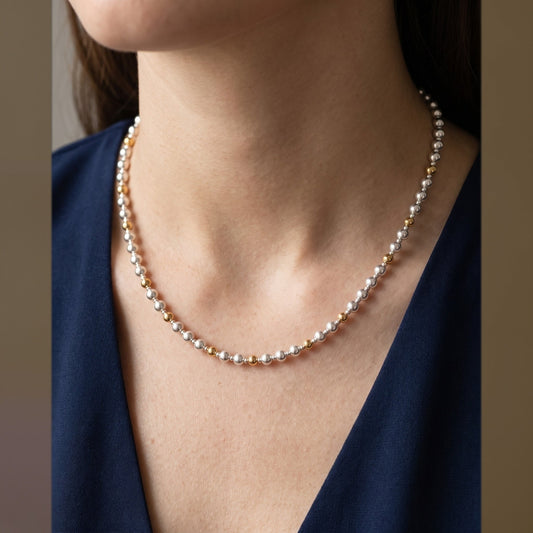
The Silver DNA Profile Necklace, £249, is the piece the certificate describes most plainly. It runs 925 hallmarked sterling silver batons with a silver spacer either side of each stone. Then 4mm stones in lapis, garnet, citrine, amethyst and amazonite mark every value in the table, in the order the fragment sizes place them. Choose 16, 18 or 20 inches, each with a 2 inch extender. After that, open the box, read the certificate first, and lift out a strand you can check against it line by line.
Frequently asked questions
What is on a DNA profile certificate?
The certificate number, the holder's name and the date come first. Then a table of the 23 markers shows the dye channel, the two values and the fragment sizes for each. Below that sit a drawn strand with every position numbered, a key of the stone colours, "Did you know" boxes and a signature.
Can I use the certificate as a legal document?
No. It is decorative and has no legal standing. It exists to show that your piece is a true reading of your profile, not to prove identity or parentage.
Does the certificate reveal anything about my health?
No. The 23 markers are identity markers, the same kind a court uses to say who, never what. They say nothing about health, ancestry, appearance or traits.
Can I share a photo of my certificate?
Share the drawing and the piece by all means, but keep the table of values private. Those readings are genetic data, so keep the certificate in the box and out of public posts.
Does every piece come with a certificate?
Every DNA Profile necklace and bracelet arrives with one, on top in the box. The DNA Representation Pendant is different, because it carries no DNA and needs no swab, so it ships from stock in 2 to 3 days with no certificate.
Ready to read your own? Explore the full DesigNA collection.
Your genetic code, profiled from a simple cheek swab and handcrafted into the exact DesigNA necklace. No two are ever the same.
Shop the collection