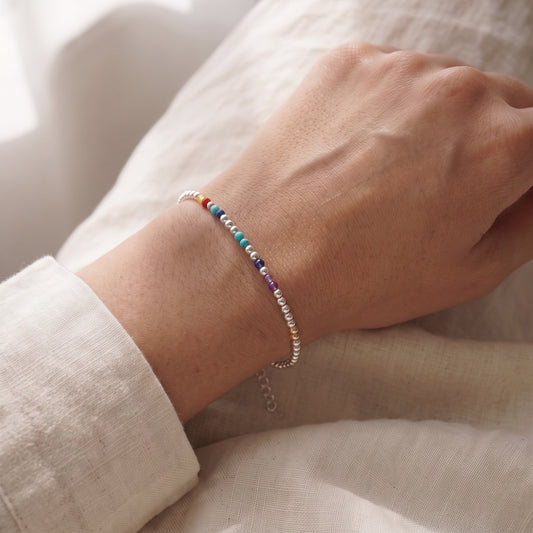
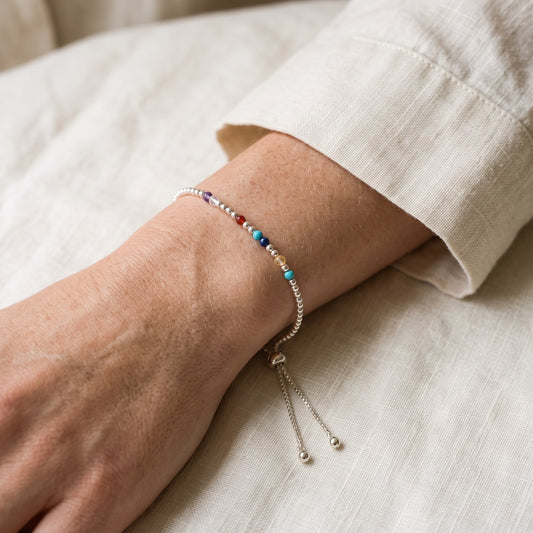
A turquoise and carnelian bracelet from DesigNA is not a colour choice. Instead, it is the fine 2mm version of the same five colour palette that runs through every piece we make. Only two stones change, the blue and the red. For example, on the necklaces and the twisted bracelets, lapis lazuli carries the blue and garnet carries the red. At 2mm, turquoise takes the blue role and carnelian takes the red, while citrine, amethyst and amazonite stay exactly where they are.
Why the palette changes at 2mm
Every DesigNA piece carries five stone colours, one for each dye the laboratory uses to read your 23 identity markers. Each marker has two values, so a piece carries about 30 stone positions. Each one sits where your fragment sizes place it. In other words, the colour stands for the dye channel, never for a choice you make. So when the stones shrink from 4mm to 2mm, the roles have to survive the change.
At 2mm, the blue and the red change stone: turquoise takes the blue role and carnelian takes the red. The yellow, purple and green stay as citrine, amethyst and amazonite at both sizes. In short, the fine bracelet tells the same story as the necklace, in a smaller voice.
What turquoise is
Turquoise is an opaque stone, sky blue to green, and one of the oldest gems people have worn, as the Gemological Institute of America describes. Copper gives it the blue. On a DesigNA fine bracelet, then, it marks every value your profile returns in the blue dye channel. That is the job lapis lazuli does on the larger pieces.
Traditionally, people have linked turquoise with protection and calm. That is a belief rather than a fact, and we make no claims for it. Instead, the stone earns its place by colour alone.
What carnelian is
Carnelian is a translucent orange to red variety of chalcedony, according to geology.com. Held to the light, for example, a 2mm carnelian glows rather than sits flat. That is why it reads so well beside silver or pearl. On the fine bracelets, it marks every value in the red dye channel, the role garnet plays at 4mm.
Warriors and creatives carried carnelian, so the tradition goes. Once again, that is a belief, not a claim we make. Every turquoise and carnelian we use is also natural, never lab grown or imitation, from established UK suppliers.
The fine bracelets: spider and clasp
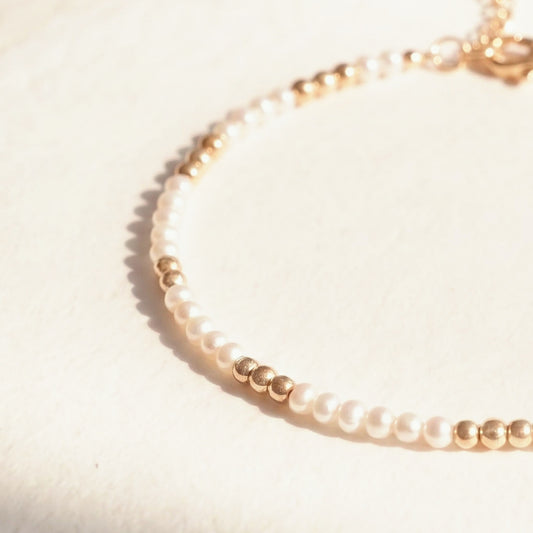
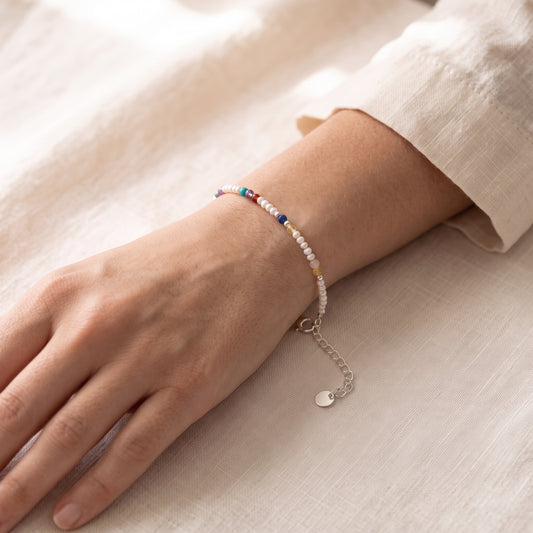
Both fine constructions, spider and clasp, use the 2mm palette. On the silver versions, 2mm stones sit against 2mm spheres of 925 sterling silver. On the pearl versions they sit against 2mm freshwater pearls instead, with no metal spheres between them, so the colour sits straight against the white.
The difference is how they close. A spider bracelet closes with a silver slider, always silver, and you draw it to the size you want. A clasp bracelet, by contrast, closes with a single lobster clasp and an extender chain ending in a small stamped 925 disc. Both carry the oval DesigNA tag. Both also read in the same order as a necklace from the same profile, only smaller. Our bracelet sizing guide helps you pick between them, and you can compare the full range in our bracelet collection.
Your turquoise and carnelian bracelet: two to start with
The Spider Silver Clasp DNA Profile Bracelet, £179, sets your 2mm stones between 2mm silver spheres on a strand that closes with a silver slider. So the bracelet range starts at £179 with it.
The Pearl Clasp DNA Profile Bracelet, £199, sets the same 2mm stones between 2mm freshwater pearls and closes with a lobster clasp and extender. Both come with the signed DNA Profile Certificate, which lists all 23 markers and draws the strand with every position numbered. The kit arrives in 2 to 3 working days. Once a UK laboratory with over 25 years in genetic testing has your swab, the piece takes 2 to 3 weeks. UK tracked delivery is free on both the kit and the bracelet.
Frequently asked questions
Why does the bracelet use turquoise instead of lapis lazuli?
Because the fine bracelets carry 2mm stones, and at that size turquoise keeps the blue bright. Lapis lazuli stays on the necklaces and twisted bracelets at 4mm, so either way the blue stone marks the same dye channel.
Is the turquoise natural?
Yes. Every stone on a DesigNA piece is natural, never lab grown or imitation, and we buy from established UK suppliers. That applies to the turquoise and the carnelian as much as the citrine, amethyst and amazonite.
Does a fine bracelet show the same profile as a necklace?
Yes. The same 23 markers sit in the same order, so a fine bracelet and a necklace from one profile match position for position. Only the blue and red stones differ, turquoise and carnelian on the bracelet, lapis lazuli and garnet on the necklace.
Spider or clasp, which should I choose?
Choose the spider if you want to draw the bracelet to size with a silver slider. Choose the clasp instead if you prefer a lobster clasp with an extender chain. Both carry the same stones and the same certificate.
Do the stones mean anything?
Traditionally, people link turquoise with protection and calm, and carnelian with warriors and creatives. However, those are beliefs, not claims we make. On a DesigNA bracelet, each stone stands for one value in your DNA profile, and that is meaning enough.
Ready to see your markers at 2mm? Explore the full DesigNA collection.
Your genetic code, profiled from a simple cheek swab and handcrafted into the exact DesigNA necklace. No two are ever the same.
Shop the collection