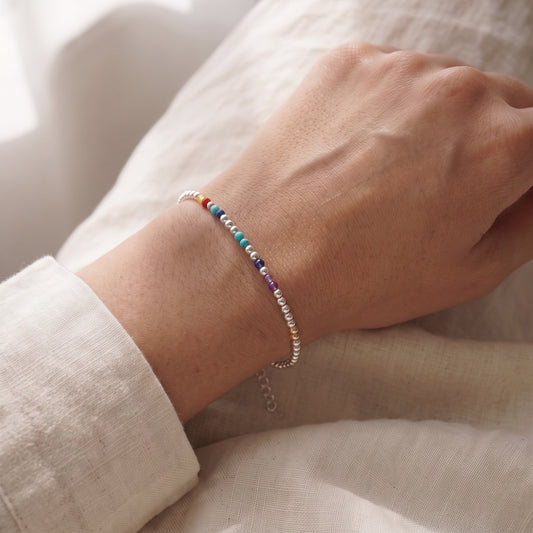
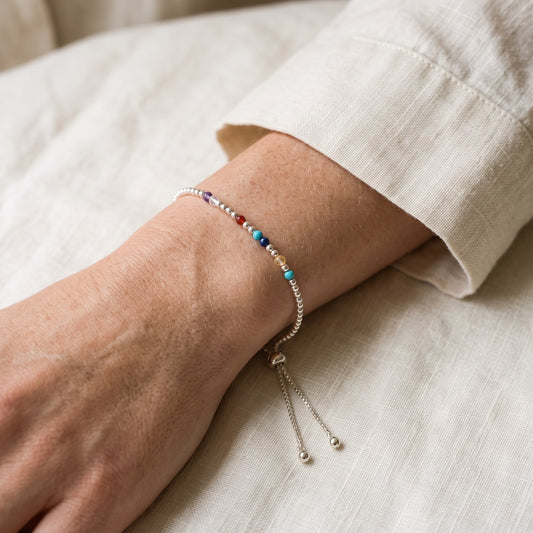
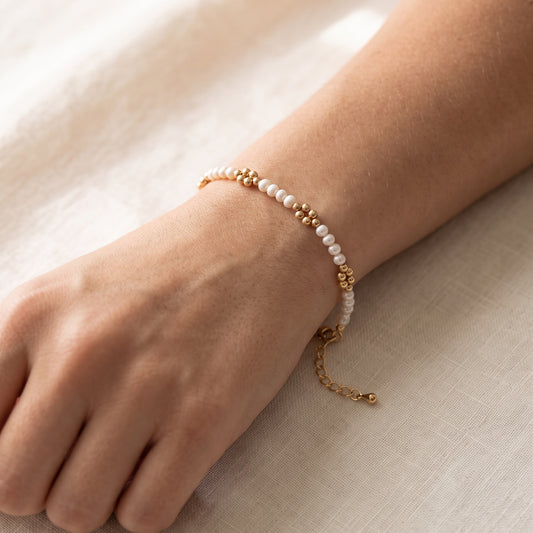
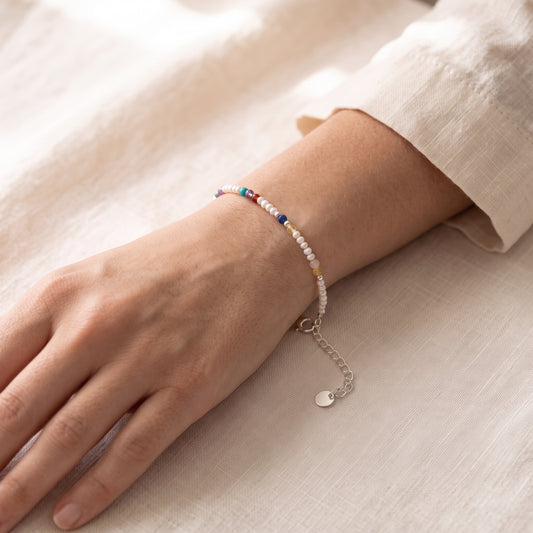
Pick up any DesigNA necklace or bracelet and look at the clasp end. The last stone is amethyst. It is amethyst on the silver pieces, on the pearl pieces and on the gold, and it will be amethyst on yours. That is not a design flourish. It is the Penta D marker, the largest fragment in the kit our laboratory uses, sitting exactly where the science puts it. This post explains the order of the strand, why Penta D always closes it, and where your identity actually lives between the two ends.
Position follows fragment size
Colour and taste play no part in the order of a DesigNA strand. The laboratory reads 23 Short Tandem Repeat markers, and for each one it records two values and a fragment size, measured in base pairs. Then the strand follows those sizes, from the smallest fragment to the largest.
So the first stone belongs to the smallest fragment and the last stone belongs to the largest. The spheres, batons or pearls hold the spaces between. In short, your DNA sets the order, and the jeweller follows it.
Why the Penta D marker is always last
The kit fixes which 23 markers the laboratory reads. The set includes well known loci such as TH01, vWA, FGA, CSF1PO, D3S1358, D16S539 and Penta D, and NIST's STRBase holds the reference data for each of them. Because the set never changes from one customer to the next, the marker with the largest fragment never changes either. In the kit our laboratory uses, that marker is Penta D.
Penta D carries the purple dye in that kit, so its stone is amethyst. Also, the strand runs from the extender chain towards the clasp, so the largest fragment lands at the clasp end. Put those facts together and the rule writes itself: the last stone on every DesigNA piece is Penta D, in amethyst, at the clasp.
The same logic fixes the start. The first stone is almost always D2S441, the smallest fragment, in the yellow stone. On necklaces and twisted bracelets that is citrine, and the fine 2mm bracelets use citrine too.
Where the identity lives
If every piece starts in yellow and ends in amethyst, what makes yours different? The values. Each marker has two values, one from each parent, and those values set the exact fragment sizes. Two people share the same 23 markers and the same five dyes, but their repeat counts differ. So the pattern between the two ends shifts from one strand to the next.
That is the part worth looking at. The ends come from the kit. Everything between them comes from you. Siblings share about half their values and differ in the rest, so their pieces differ. Only identical twins would share the whole pattern, because they share the whole profile.
Why the amethyst is a good place to finish
We did not choose amethyst, the science did. However, we are glad it fell that way. Traces of iron give amethyst its purple, in a quartz the Gemological Institute of America describes in full on its amethyst page. On a traditional reading, amethyst stands for calm and clarity. We share that as a belief, never a medical claim.
The amethyst also sits beside the clasp, and on DesigNA pieces that is where the oval DesigNA tag hangs, silver on silver pieces and gold on gold. So the clasp end carries the two things that mark a finished piece: the last marker and the DesigNA tag.
Your DNA Profile Certificate shows all of this. It lists the 23 markers with their dye channel, values and fragment sizes. It also draws the strand with a position number for each marker. So you can find Penta D on the paper, then on your wrist or neck. Our page on the science goes further.
The piece that shows the order best: the Silver Sphere DNA Profile Necklace
Here is the one to choose. The Silver Sphere DNA Profile Necklace, £259, shows the run from citrine to amethyst most clearly. Polished 5mm spheres in 925 hallmarked sterling silver hold the spaces between the stones, with a silver spacer either side of each one. So every marker sits in its own pool of light. It comes in 16, 18 or 20 inches with a 2 inch extender. The strand runs from the extender chain, with its stamped 925 disc, to a silver clasp with the oval DesigNA tag.
The kit arrives in 2 to 3 working days. Take the swab at home and post it back in the prepaid envelope. Then our partner jeweller in Birmingham's Jewellery Quarter strings the spheres and stones by hand, from the extender chain towards the clasp. The piece takes 2 to 3 weeks from the day the laboratory has your swab. Free UK tracked delivery covers the kit and the necklace.
Frequently asked questions
What is the Penta D marker?
Penta D is one of the 23 Short Tandem Repeat identity markers in the kit our laboratory uses. It has the largest fragment size of the set, so it always sits last on a DesigNA strand. NIST's STRBase holds its reference data.
Why is the last stone always amethyst?
Because position follows fragment size and the kit fixes the markers. Penta D is the largest fragment and carries the purple dye in that kit, so its amethyst stone always closes the strand at the clasp end.
What is the first stone?
Almost always D2S441, the smallest fragment, in the yellow stone. On necklaces and twisted bracelets that is citrine, and the fine 2mm bracelets use citrine too.
If the ends are the same, how is my piece one of one?
The ends come from the kit, but the values come from you. Your repeat counts set the exact fragment sizes, so the pattern between the first and last stone differs from everyone else's, apart from an identical twin.
Can I change the order of the stones?
No. The order is the reading, from smallest fragment to largest, and changing it would break the link between the piece and the certificate. The certificate draws the strand with a position number for each marker so you can check it.
Ready to find your own Penta D? Explore the full DesigNA collection.
Your genetic code, profiled from a simple cheek swab and handcrafted into the exact DesigNA necklace. No two are ever the same.
Shop the collection