Home/DNA Jewellery/9 Precious Stones or Something Else? The DNA Necklace Materials FAQ
Before you buy a DNA necklace, it is fair to ask exactly what you are getting. Some shoppers arrive expecting a fixed set of semi precious stones. Others wonder whether the colour is an artificial gem standing in for something more meaningful. Both are honest questions, so this FAQ explains what a DesigNA necklace is really made from, and how your DNA shapes it.
In short, every DesigNA necklace is built from semi precious stones and precious metal. Every necklace uses the same five semi precious stones, one for each of the dyes used to read your DNA: lapis lazuli, garnet, citrine, amethyst and amazonite. They are set as coloured markers along the chain in the exact order your DNA places them. Read on for the full detail, plus the other questions buyers ask most before checkout.
In this article
Does a DesigNA Necklace Use A Set Number of Semi Precious Stones?
Not in the way the question assumes. A DesigNA necklace is not a fixed arrangement of precious stones, and the stones are semi precious rather than precious. Instead, five fixed semi precious stones stand for the five dyes used to read your DNA, and they appear as markers along the strand in the order your own profile places them.
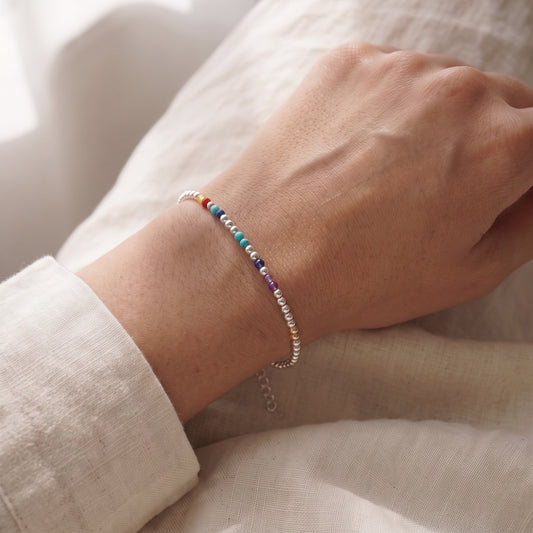
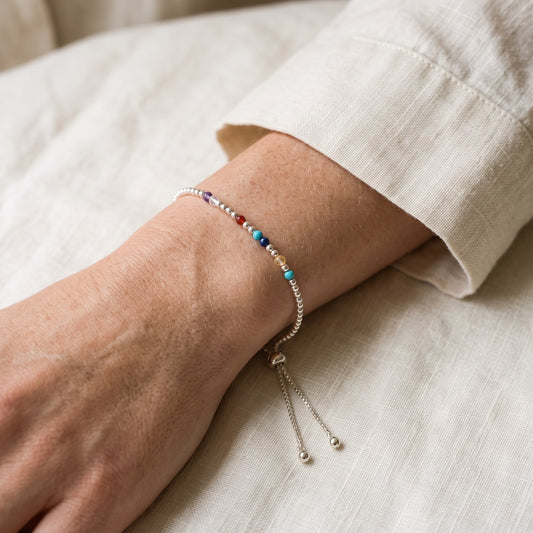
The number of stones on your piece is decided by your own DNA, not by a set count. A laboratory reads twenty three markers from your genetic profile, and each marker appears as a stone in one of your chosen colours, arranged in the order your DNA places it. Metal spheres and tubes sit between the stones as the spaces in the sequence. The result is a strand that maps your genetic code, which is why no two necklaces are ever the same.
What Stones Does DesigNA Use, and How Many?
The palette is fixed: lapis lazuli, garnet, citrine, amethyst and amazonite. Those five stones repeat along the strand as your markers, so the total number of stones follows your own sequence rather than a fixed figure.
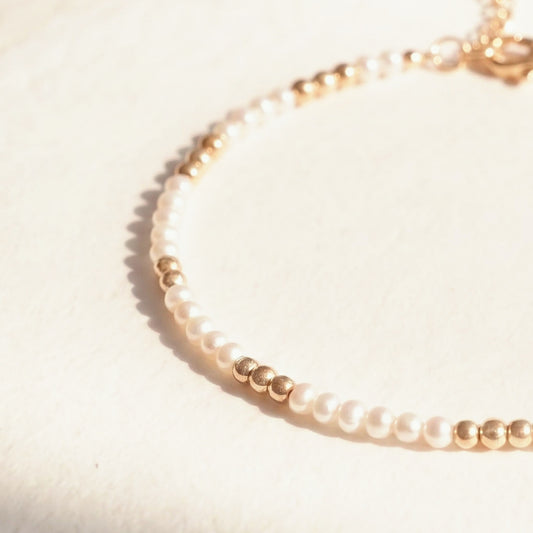
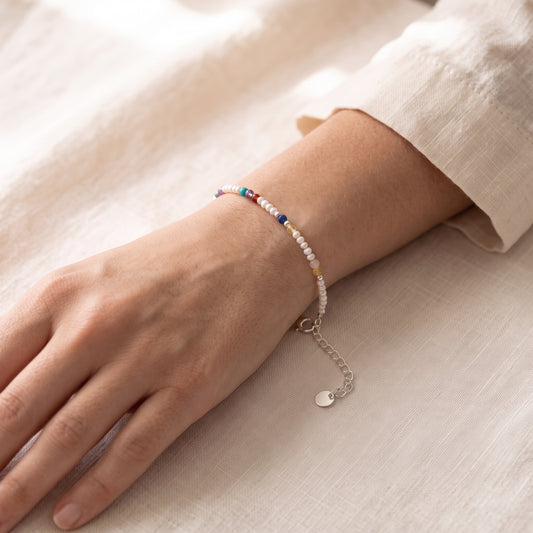
Metal and pearl frame the stones depending on the piece. The Silver necklace sets your stones along 925 sterling silver. The Gold necklace uses 9ct gold with gold filled spacers. The Pearl necklace strings your stone markers between genuine freshwater pearls on silver. Every version is handmade to order in the UK by a partner jeweller in Birmingham. For the full comparison, see our buyer’s guide to DNA necklaces.
Are the Stones Real, or an Artificial Gem?
The stones are real semi precious stones, not artificial gems. What makes the piece personal is not the stones alone but the pattern they form. The colours and their order come from your own genetic profile, mapped by a laboratory from a simple cheek swab, so the arrangement belongs to you alone and cannot be recreated for anyone else.
This differs from generic DNA inspired jewellery, which often reuses the same double helix graphic or a fixed cluster of crystals for every customer. To understand the full journey from swab to finished piece, read how your DNA becomes a necklace.
How Does Collecting DNA for the Necklace Work?
Collecting your sample is simple and happens entirely at home. First, DesigNA posts a sampling kit to your address, containing a cheek swab, plain instructions, and a return envelope with postage paid. Next, you swab the inside of your cheek for about sixty seconds, seal the sample, and post it back.
There is no clinic visit, no blood draw, and no specialist equipment needed on your end. Once the laboratory receives your sample, it reads your markers under UK data protection standards, and the sample is used only to generate your necklace pattern. Genetic data is sensitive information, so DesigNA treats it accordingly at every stage. The Information Commissioner’s Office explains why this category of data carries extra protection under UK law.
Why Semi Precious Stones and Metal Together?
The stones carry the colour of your genetic markers, and the metal gives the piece its structure and holds the sequence in place. Together they turn an invisible code into something you can wear every day. Semi precious stones were chosen over diamonds and other precious stones because the meaning lives in the pattern, not in the price of a single gem.
The Pearl necklace adds one more layer of natural uniqueness. A freshwater pearl forms slowly and never repeats, which pairs naturally with a one of one design. The Gemological Institute of America notes that freshwater pearls develop their lustre through a process no two pearls share.
Ready to Choose Your Necklace?
Now that you know exactly what goes into a DesigNA necklace, the next step is choosing the material that suits you. Silver is £249, Pearl is £275 and Gold is £699, all handmade to order in the UK.
Browse the full range at DesigNA
Frequently Asked Questions
Does a DesigNA necklace contain 9 precious stones?
Not as a fixed set. A DesigNA necklace uses five fixed semi precious stones, one per dye, set as coloured markers along the strand in the order your own DNA places them. Those stones are set as coloured markers along the chain in the order your own DNA places them, so the arrangement reflects your genetic profile rather than a fixed count of nine.
What stones and materials does DesigNA use?
Every necklace uses the same five stones: lapis lazuli, garnet, citrine, amethyst and amazonite. They are set along 925 sterling silver, 9ct gold with gold filled spacers, or between freshwater pearls on silver. Every necklace is handmade in the UK from £249.
Are the stones real or artificial?
They are real semi precious stones. What cannot be copied is the pattern they form, because the colours and their order come from your own DNA profile, mapped from a cheek swab and unique to you.
How does collecting DNA for the necklace work?
DesigNA posts a sampling kit to your home. You complete a simple cheek swab, seal it, and return it in the envelope provided. A UK laboratory then reads the sample under full data protection standards to generate your necklace pattern.
How many stones will my necklace have?
It depends on your DNA. The laboratory reads twenty three markers, and each marker appears as one of the five stones, with metal spheres as the spaces between. Because your sequence is unique, the exact arrangement is one of one.
Your genetic code, profiled from a simple cheek swab and handcrafted into the exact DesigNA necklace. No two are ever the same.
Shop the collection