Your DNA Is Unique: Here’s What That Actually Means

You’ve heard it said a thousand times: you’re one of a kind. But what does that actually mean, scientifically? And how unique is your DNA, really?
The Numbers Behind Your Uniqueness
The human genome contains roughly 3 billion base pairs of DNA. Across the entire human population, around 99.9% of that DNA is identical between any two people, we’re all, fundamentally, the same species. But that remaining 0.1%? That’s where everything interesting happens.
That 0.1% difference translates to approximately 3 million unique genetic variations in your genome. The probability of two unrelated people sharing the same DNA profile is less than one in a billion billion. In practical terms, it’s impossible.
What Are STR Markers, and Why Do They Matter?
One of the most powerful tools in DNA profiling is the analysis of Short Tandem Repeats, or STRs. These are short sequences of DNA, typically two to six base pairs long, that repeat back to back at specific locations in your genome.
For example, a sequence like “AGAT” might repeat 7 times at one location in your genome, and 12 times at the same location in someone else’s. The number of repeats you carry at each STR location is inherited from your parents, half from your mother, half from your father, making your specific combination entirely your own.
Forensic scientists have used STR analysis for decades to identify individuals with near absolute certainty. It’s the same science behind paternity tests, criminal DNA databases, and ancestral research. And it’s the same science that sits at the heart of every DesigNA piece.
Why No Two DesigNA Pieces Are Ever the Same
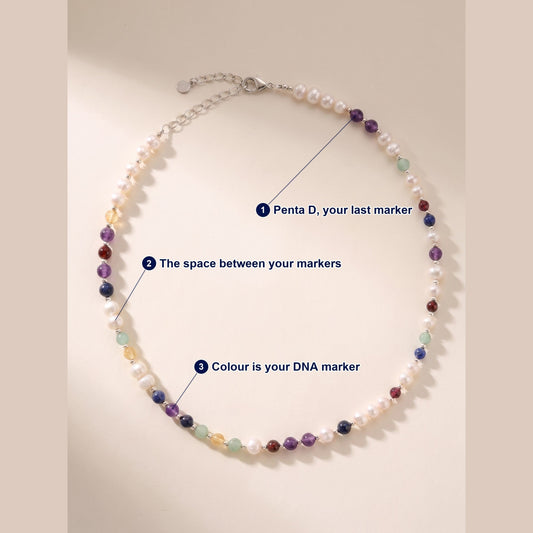
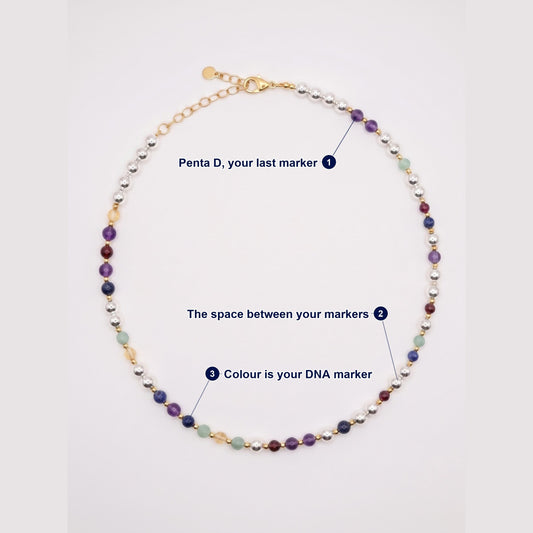
When you order a DesigNA necklace, we work with our laboratory partner to extract and analyse your DNA sample. Using advanced STR analysis across multiple genetic markers, we generate a profile that is as unique to you as a fingerprint, more so, in fact.
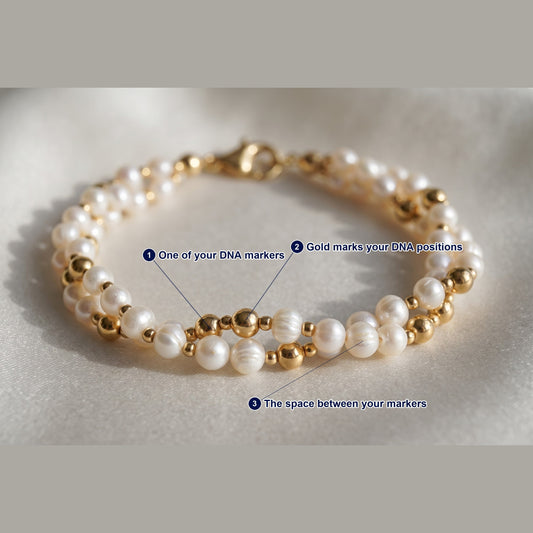
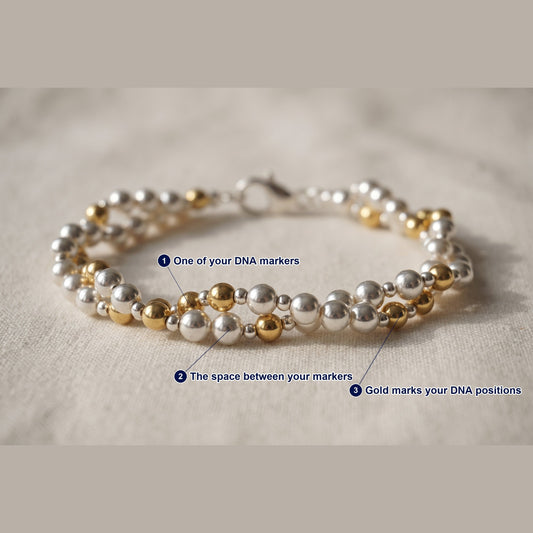
That profile is then translated directly into the arrangement of semi precious stones on your necklace. Each stone type, each colour, each position corresponds to specific genetic data points drawn from your profile. The result isn’t decorative in the conventional sense, it’s a physical, wearable representation of your genetic code.
Not approximate. Not inspired by. *Derived from.*
What About Identical Twins?
Identical twins come from a single fertilised egg and share virtually the same DNA. Standard identity profiling reads them almost identically, so their pieces would be very close to one another.
If you are ordering for twins, add a note with your samples and we will talk you through it before anything is made.
What It Does Not Tell You
A DesigNA piece is a design, not a report. The markers the laboratory reads are identity markers, the kind used to tell one person from another. They say nothing about your health, your risk of disease or your ancestry, and DesigNA does not produce a health or ancestry breakdown.
Parents, Children and Siblings
Close family members share roughly half their DNA, so at each marker they often carry one value in common. Their pieces can share some positions along the strand, but the full pattern still differs from one person to the next.
Your Identity, Made Permanent
We live in a world of mass production, where “personalised” often means little more than your name laser engraved on a keyring. DesigNA exists to offer something genuinely different: jewellery that is structurally, scientifically, impossibly yours.
Because your DNA, and only your DNA, could produce it.
Explore our collection and begin your DNA profile necklace.
Your genetic code, profiled from a simple cheek swab and handcrafted into the exact DesigNA necklace. No two are ever the same.
Shop the collection