An adjustable DNA bracelet answers the question every gift buyer dreads. What size? The spider bracelets in our range have no clasp at all. Instead, two fine chains run through a central silver slider, and you pull the chains to the size you want. The slider holds, and there is nothing to unclip. So this post explains how the spider fastening works and why we always make the slider in silver. It also covers the four bracelets that use it, and why it is the right choice for an unknown wrist.
How the spider slider works
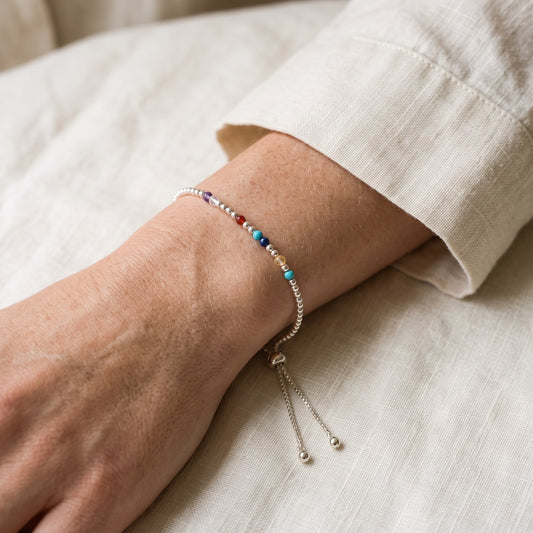
Picture the bracelet laid flat. The strand of 2mm spheres and stones forms a loop, and from each end of that loop runs a fine chain. Both chains pass through a small silver slider at the back of the wrist. Each one finishes in a tiny ball, so it cannot pull through. To put the bracelet on, you slip it over the hand and pull the two ball ends. The loop tightens, the slider grips, and the bracelet sits where you left it. Then, to take it off, you ease the slider back.
There is no lobster clasp, no extender chain and no fiddly catch. The name comes from the way the two chains spread from the slider like legs. We described the two fittings in DNA bracelet sizing, and the spider is the one for an unknown wrist.
Why the slider is always silver
Every spider bracelet uses a silver slider, even the "and gold" versions. The reason is practical. The slider is the moving part, and 925 sterling silver takes the wear well, so we keep it the same across the range. Sterling silver is 92.5 percent silver. Also, the Birmingham Assay Office in the Jewellery Quarter is where silver like ours carries its hallmark. On the gold versions, the gold filled spheres sit along the strand and the silver slider does the holding.
The four spider bracelets
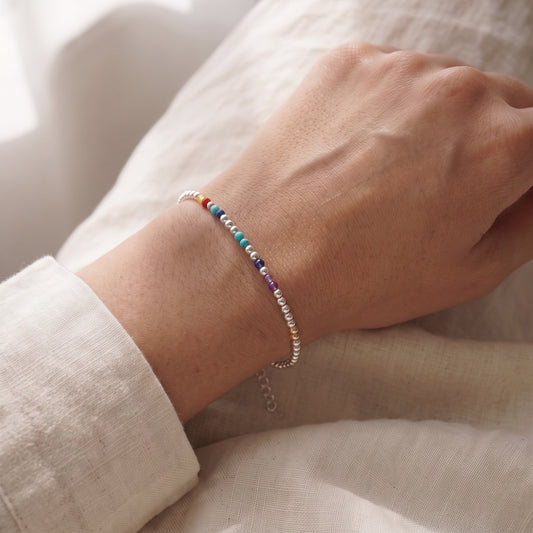
First, the Spider Silver Clasp DNA Profile Bracelet, £179. Fine 2mm polished sterling silver spheres with 2mm stones in turquoise, carnelian, citrine, amethyst and amazonite, one stone per dye colour. It is the quietest piece in the range and the one to start with.
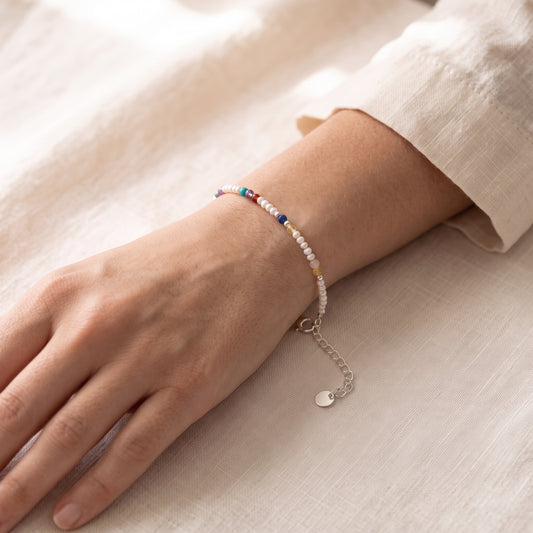
Second, the Spider Pearl Clasp DNA Profile Bracelet, £199. Genuine 2mm freshwater pearls take the place of the silver spheres, with the same five stones. On the fine pearl bracelets there are no metal spheres between the pearls and the stones, so the strand reads as pearl and colour alone.
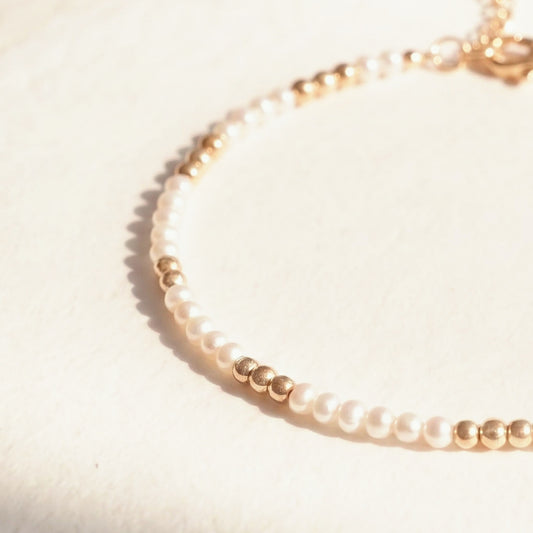
Third, the Spider Silver and Gold DNA Profile Bracelet, £199. A pattern piece. Gold filled 2mm spheres sit at the marker positions instead of coloured stones, and the identity lives in where they fall. Finally, the Spider Pearl and Gold DNA Profile Bracelet, £199, puts the same gold positions among 2mm pearls. Bracelets start at £179.
Why the fine bracelets swap two stones
The spider bracelets share the 2mm palette with our clasp bracelets, and it differs from the necklaces in two places. Turquoise takes the blue dye instead of lapis lazuli, and carnelian takes the red instead of garnet. At 2mm, those two stones hold their colour better at the smaller size. Citrine, amethyst and amazonite stay the same. Our post on turquoise and carnelian explains the swap.
The reading behind the bracelet never changes. The laboratory reads 23 Short Tandem Repeat markers from a cheek swab, and each value becomes a stone placed by fragment size. Because the kit fixes the markers, the strand almost always opens with D2S441 in citrine and always closes with Penta D in amethyst. On a spider bracelet that amethyst sits at the slider end, where the strand finishes.
Who the adjustable DNA bracelet suits
First, anyone buying for a wrist they have never measured. Anyone who wants a bracelet that stays on through a shower and a swim without a catch to check. Anyone who stacks bracelets, because a slider sits flat under a watch strap or beside a bangle. Also, anyone with a very slim or a very broad wrist, since the slider does not care. Our post on stacking DNA bracelets shows the combinations.
The Spider Pearl and Gold DNA Profile Bracelet, £199
If you want the spider idea at its prettiest, choose the Spider Pearl and Gold DNA Profile Bracelet, £199. Fine 2mm freshwater pearls carry the strand, 2mm gold filled spheres mark every position in the profile, and a silver slider holds it at any size. It carries no coloured stones, so it reads as pearl and gold until the wearer explains the pattern.
The kit arrives in 2 to 3 working days. The wearer takes their own cheek swab at home and posts it back in the prepaid envelope. Then the bracelet takes 2 to 3 weeks from the day the laboratory has the swab, with free UK tracked delivery on both. For Christmas, order by Sunday 15 November 2026.
Frequently asked questions
How does the spider slider work?
Two fine chains run from the ends of the strand through a central silver slider, each finishing in a small ball. Pull the balls to tighten the bracelet, and the slider grips. Ease it back to take the bracelet off.
Will it fit any wrist?
Yes. The slider adjusts to any size, from very slim to broad, which is why we suggest it when you do not know the wearer's wrist.
Is the slider silver on the gold bracelets?
Yes. Every spider bracelet uses a 925 sterling silver slider, because it is the moving part and silver takes the wear well.
Which spider bracelet should I choose first?
The Spider Silver Clasp DNA Profile Bracelet, £179, is the quietest and the most popular place to start. The pearl, silver and gold, and pearl and gold versions are £199 each.
Can the spider bracelet come off by accident?
The slider holds the chains firmly once pulled to size, and there is no catch to open. Ease the slider back deliberately to remove it.
Ready for a bracelet that fits before you know the size? Explore the full DesigNA collection.
Your genetic code, profiled from a simple cheek swab and handcrafted into the exact DesigNA necklace. No two are ever the same.
Shop the collection