DNA fingerprinting is one of the few scientific breakthroughs with an exact birthday. It happened on the morning of 10 September 1984, in a laboratory at the University of Leicester, when Alec Jeffreys pulled an X ray film out of a developing tank and saw a pattern nobody had seen before. Every DesigNA piece descends from that film. So this post tells the story in plain English, then follows the technique from 1984 to the 23 markers on your certificate.
The morning DNA fingerprinting began
Jeffreys was studying minisatellites, stretches of DNA that repeat themselves and vary a great deal from one person to the next. According to the Science Museum's account, the DNA on that first film came from his technician, Vicky Wilson. The pattern of bands showed which parts of her DNA came from each parent, and it also formed a code that belonged to her alone. In other words, a stretch of repeating DNA could identify a person.
The first use was not a crime. Jeffreys's wife, Sue, suggested immigration disputes, and the technique soon confirmed that a boy from a Ghanaian family was related to people already living in the UK. Police work followed, first in the investigation of two murders in Narborough, Leicestershire. From there, paternity cases, wildlife studies and courtrooms around the world picked it up.
From minisatellites to short tandem repeats
The 1984 method read long repeats, up to about 100 bases, and it needed a good deal of DNA. Modern profiling reads something shorter. Wellcome's yourgenome describes short tandem repeats, or STRs, as the shorter relatives of minisatellites, usually two to five base pairs long. Because the repeats are short, a laboratory can copy them from a tiny sample, such as the cells on a cheek swab, and read them by machine.
The reading method changed too. Instead of bands on a film, a modern profile appears as a series of coloured peaks. The laboratory tags each marker with a fluorescent dye, separates the fragments by size, and records where each peak falls. That is exactly what happens to a DesigNA swab. The laboratory, a UK laboratory with over 25 years in genetic testing, reads 23 STR markers in five dye colours, then records two values for each marker, one from each parent. Our page on the science walks through the method step by step.
What a DNA fingerprint actually says
Here is the part people often get wrong. A profile does not read genes. The markers sit in stretches of DNA chosen because they vary between people, not because they do anything in particular. So a profile can say who, with great confidence, but it cannot say what. It says nothing about health, ancestry, appearance or character. That was true of Jeffreys's film in 1984, and it is true of the table on a DesigNA certificate today.
Jeffreys himself later argued that people should control access to their own genetic information. We agree, and we built the business around it. An adult always takes their own swab, with their own consent, on the form in the kit. The laboratory destroys the sample after profiling, and we delete the marker data after the piece arrives. Your DNA and privacy sets out the full policy.
How the fingerprint becomes a strand
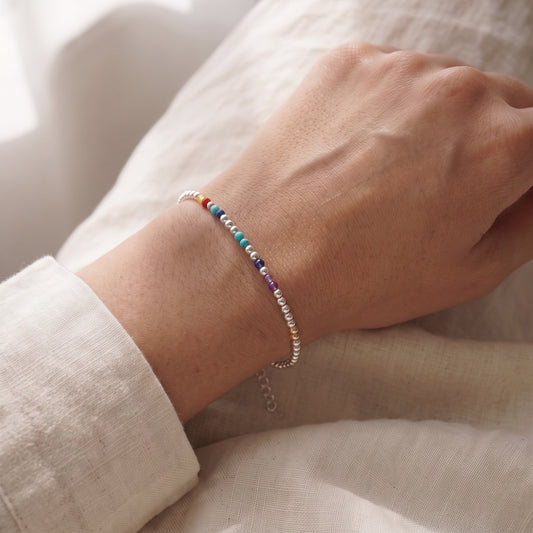
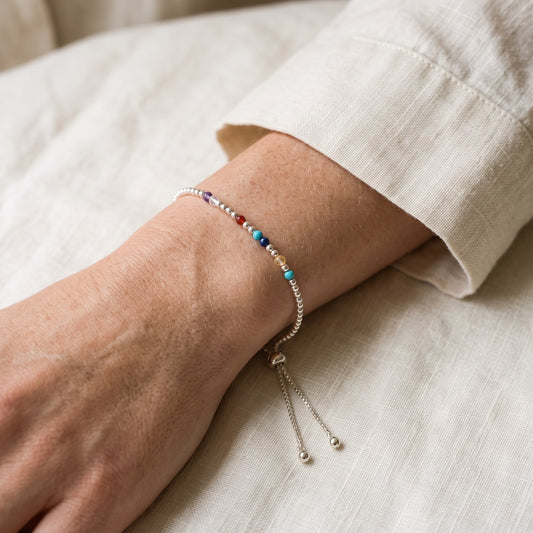
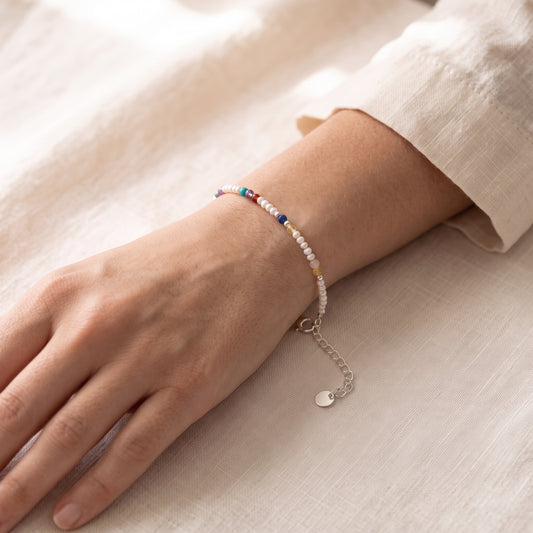
Once the laboratory has the 23 markers, the science is finished and the making begins. Each value has a fragment size, measured in base pairs. The strand follows those sizes from the smallest fragment to the largest, and every value becomes a stone in the colour of its dye. On necklaces and twisted bracelets that means lapis lazuli for blue, garnet for red, citrine for yellow, amethyst for purple and amazonite for green. Spheres, batons or pearls hold the spaces between.
Because the kit fixes the markers, two facts hold for every piece. First, the strand almost always opens with D2S441 in the yellow stone. Then, at the clasp end, it always closes with Penta D in amethyst. Everything between those two ends comes from the wearer's own values. For a longer explanation, read why the laboratory reads 23 DNA markers.
The piece that shows the fingerprint most clearly: the Silver DNA Profile Necklace, £249
If you want to see the 1984 idea as jewellery, start with the Silver DNA Profile Necklace, £249. Polished batons in 925 hallmarked sterling silver run between the stones, with a silver spacer either side of each one, so every marker reads clearly against the metal. Choose 16, 18 or 20 inches, each with a 2 inch extender. It closes with a silver clasp and the oval DesigNA tag.
The kit arrives in 2 to 3 working days with free UK tracked delivery. Take the swab at home, post it back in the prepaid envelope, and the piece takes 2 to 3 weeks from the day the laboratory has it. The certificate in the box lists every marker, value and fragment size, so you can trace the line from Leicester to your own neck. For Christmas, order by Sunday 15 November 2026.
Frequently asked questions
Who invented DNA fingerprinting?
Alec Jeffreys, at the University of Leicester, on 10 September 1984. He was studying repeating stretches of DNA called minisatellites when he saw that the pattern could identify an individual. He was later knighted for the work.
Is DNA fingerprinting the same as DNA profiling?
They share the idea, but the method moved on. Modern profiling reads short tandem repeats, usually two to five base pairs long, and shows them as coloured peaks rather than bands on a film. A DesigNA piece uses the modern method, with 23 markers read in five dye colours.
Does a DNA fingerprint reveal my health?
No. The markers sit in stretches of DNA chosen because they vary between people. They say who, never what, so a profile holds nothing about health, ancestry, appearance or traits.
Can anyone take my DNA fingerprint without my consent?
Not for a DesigNA piece. An adult always takes their own swab and gives their own consent on the form in the kit. A child's piece needs written consent first from a parent or guardian with parental responsibility.
Does the piece contain my DNA?
No. The necklace or bracelet carries the pattern of the profile, not the DNA itself. The laboratory destroys the sample after profiling, and we delete the marker data after the piece arrives.
Ready to see your own fingerprint as a strand? Explore the full DesigNA collection.
Your genetic code, profiled from a simple cheek swab and handcrafted into the exact DesigNA necklace. No two are ever the same.
Shop the collection