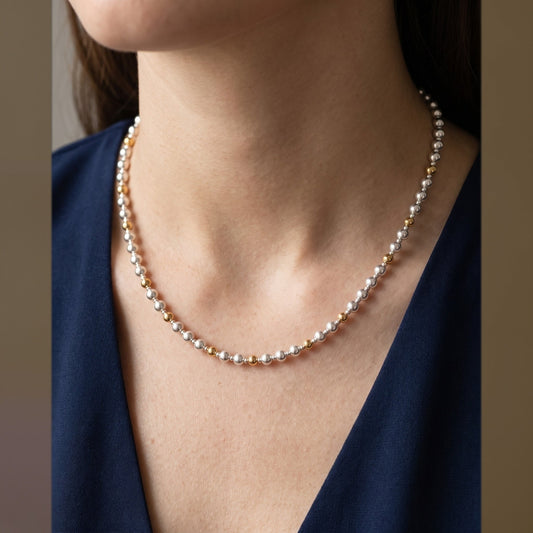
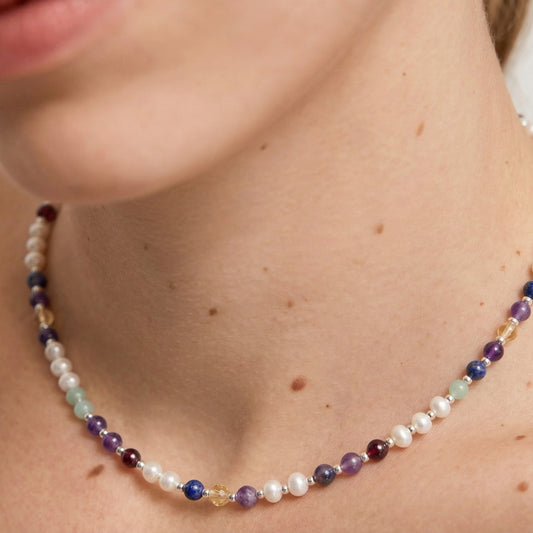
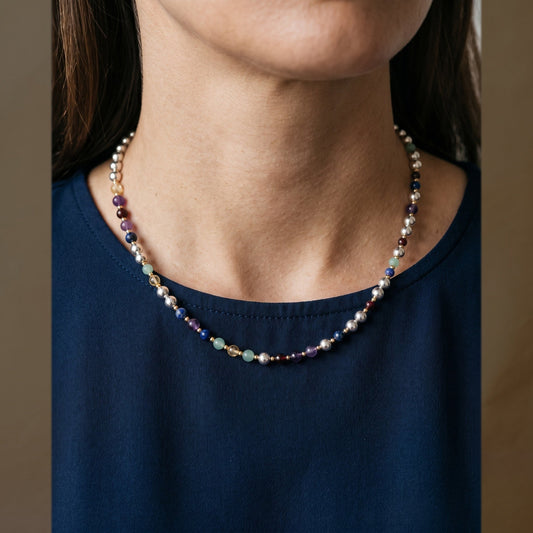
Hallmarked silver jewellery carries a small promise. Somebody independent has tested the metal and marked it, so the number on the piece means what it says. On a DesigNA necklace, for example, the number 925 sits on a tiny disc at the end of the extender chain. This post explains what 925 and 9ct mean and what the Hallmarking Act asks of a UK jeweller. It also explains why we use these metals rather than plating for the parts that sit on your skin all day.
What 925 means on hallmarked silver jewellery, and what 9ct means
Sterling silver is 92.5 percent silver, and that figure is where the 925 comes from. The rest is other metal, because pure silver is too soft to hold a clasp or a sphere in shape. So 925 is the standard for silver jewellery meant for daily wear, and it is the only silver we use.
Gold works the same way, with a different number. 9ct gold is 375 parts per thousand gold, so the mark on a 9ct piece reads 375. The carat tells you how much of the metal is gold, and the fineness number says the same thing in thousandths. Our Gold DNA Profile Necklace uses 9ct hallmarked gold for its batons and its clasp. It is not 18ct, and it is not solid gold from end to end, because the spacers and the extender chain use gold filled metal instead. Gold filled means a thick layer of gold bonded to a base metal core, far thicker than plating.
What the Hallmarking Act asks for
In the UK, the Hallmarking Act 1973 requires gold and silver items above set weights to carry an independent hallmark. Without one, nobody may sell them as gold or silver. An assay office tests the metal first, and then it strikes the mark. That is the difference between a hallmark and a maker's own stamp. In other words, the maker does not test their own work. The government publishes hallmarking guidance notes that set out the detail for anyone who sells precious metal.
Birmingham has its own Assay Office, and our partner jeweller works in Birmingham's Jewellery Quarter. So every DesigNA piece takes shape there, in the UK, by hand. The address belongs to the jeweller rather than to us, but the standards travel with the piece.
The stamped 925 disc on the extender
Every silver DesigNA necklace ends in a lobster clasp and an extender chain. At the tip of the chain hangs a small disc stamped 925. It is the last thing the jeweller fits and the first thing most people look for. An oval DesigNA tag sits at the clasp end as well, silver on the silver pieces and gold on the gold ones.
The silver itself, though, runs right through the piece. On the necklaces and the twisted bracelets, 5mm spheres of 925 sterling silver hold the spaces between the stones. On the fine bracelets those spheres drop to 2mm. The Silver DNA Profile Necklace uses batons instead of spheres. In every case a 925 silver spacer sits either side of each stone, so the stone never rubs directly on its neighbour.
Why we use 925 and 9ct rather than plating
Spheres, batons and clasps sit against skin all day. Plated metal carries only a thin coat of gold or silver over a base, and that coat wears through at the points of contact. Once it goes, the base metal shows. The hallmarking guidance notes make the same point in law, because a plated item cannot carry a gold hallmark.
So we use 925 sterling silver throughout the silver pieces, and 9ct hallmarked gold for the batons and clasp of the gold necklace. Where a piece needs gold at a lower price, we choose gold filled rather than plated. So that covers the spacers, the extenders and the spheres of the pattern pieces. In short, nothing that touches your skin on a DesigNA piece relies on a coating.
Two necklaces, one certificate
The Silver DNA Profile Necklace, £249, sets your 4mm stones along 925 hallmarked sterling silver batons. A 925 spacer also sits either side of each stone. It closes with a silver lobster clasp, a 2 inch extender and the stamped 925 disc. Lengths run 16, 18 or 20 inches.
The Gold DNA Profile Necklace, £699, sets the same stones along 9ct hallmarked gold batons with a 9ct clasp. Gold filled spacers and a gold filled extender then finish it. Both necklaces come from the same reading by a UK laboratory with over 25 years in genetic testing. Both arrive with the signed DNA Profile Certificate on top of the box. The kit reaches you in 2 to 3 working days, and the piece takes 2 to 3 weeks once the laboratory has your swab. UK tracked delivery is free on both.
Frequently asked questions
What does 925 mean on silver jewellery?
It means sterling silver, 92.5 percent silver by weight. The rest is other metal, which gives the silver the strength to hold a clasp, a sphere or a baton in shape. All the silver on a DesigNA piece is 925 hallmarked sterling silver.
Is 9ct gold real gold?
Yes. 9ct gold is 375 parts per thousand gold, and the Gold DNA Profile Necklace uses 9ct hallmarked gold for its batons and clasp. We never describe it as 18ct, because it is not.
Are the gold filled parts hallmarked too?
No. A hallmark describes the precious metal content of the metal itself, so it applies to the 925 silver and the 9ct gold. Gold filled parts carry a thick layer of gold bonded to a base core, and they carry no gold hallmark.
Where is the 925 mark on my necklace?
Look at the end of the extender chain. The small disc there carries the 925 stamp. The oval DesigNA tag, by contrast, sits at the other end by the clasp.
How do I look after hallmarked silver?
Warm water and a soft cloth are all it needs. Never use an ultrasonic cleaner, and store the piece flat in its box after wearing. Every DesigNA piece also carries a six month warranty, and our jewellery care page has the full routine.
Ready to see your markers in silver or gold? Explore the full DesigNA collection.
Your genetic code, profiled from a simple cheek swab and handcrafted into the exact DesigNA necklace. No two are ever the same.
Shop the collection