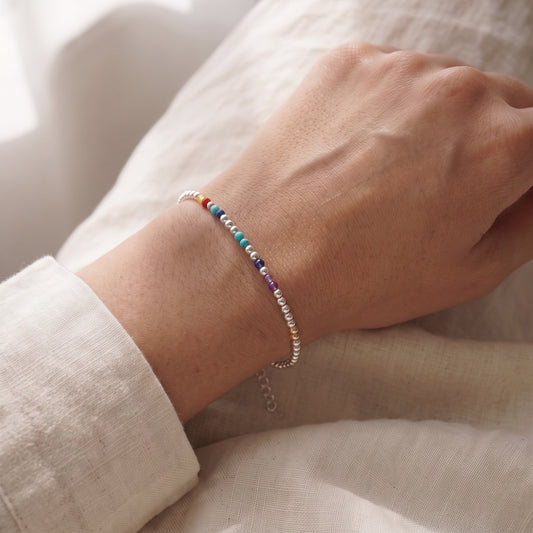
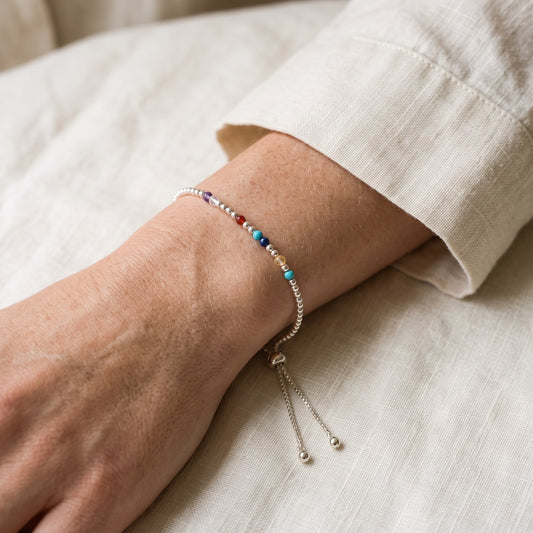
The twisted DNA bracelet is the fullest piece in our bracelet range, and the only one built from two strands. Our partner jeweller strings each strand by hand, then winds the pair into a single rope. The result has more body on the wrist than a flat strand. Also, the stones show from more than one angle as the rope turns. So this post explains how the two strands carry one profile, why the spheres are larger, and what the clasp end looks like.
One profile across two strands
Every DesigNA piece follows the same reading. The laboratory reads 23 Short Tandem Repeat markers from a cheek swab and records two values for each. Then the values become stones, placed along the strand by fragment size. On a necklace that is one long run from the extender chain to the clasp, as how DesigNA works shows. On a twisted DNA bracelet the run splits in two.
The reading starts on the first strand and continues on the second. In other words, the first half of your positions sits on one strand and the second half on the other. Then the jeweller winds the two together, so the two halves wrap around each other along the wrist. The certificate in the box draws the strand with every position numbered, so you can still find each marker on the rope. For the general rule behind the order, read why the last stone is always amethyst.
Why the spheres are 5mm
Our fine bracelets use 2mm spheres and 2mm stones, so they sit close to the wrist and pass for a plain bracelet from any distance. The twisted bracelet does the opposite. It uses 5mm spheres, the same size as our Silver Sphere necklaces, with 4mm stones between them. Because the strands twist, a smaller sphere would lose the pattern in the turn. The larger size keeps every stone readable as the rope rotates.
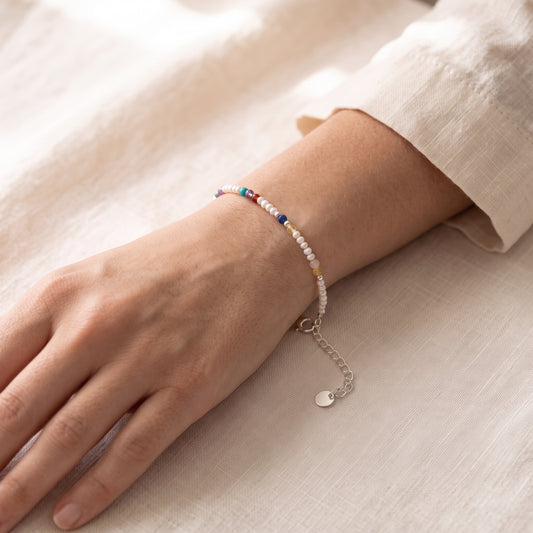
The stones are the necklace palette too. Lapis lazuli for blue, garnet for red, citrine for yellow, amethyst for purple and amazonite for green, one stone per dye. On the Twisted Silver DNA Profile Bracelet, polished 925 hallmarked sterling silver spheres carry the run. A silver spacer sits either side of each stone. On the twisted pearl ropes, 5mm genuine freshwater pearls take the place of the silver spheres. The twisted pearl rope is the only pearl bracelet in the range with metal spacers beside the stones.
The "and gold" versions carry no stones
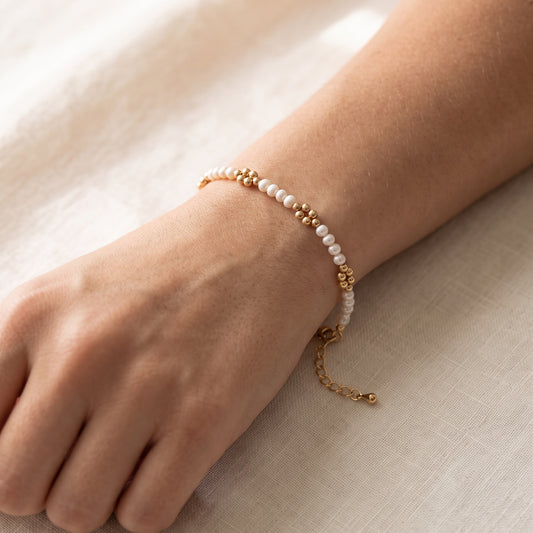
Two of the four twisted bracelets are pattern pieces. On the Twisted Silver and Gold and the Twisted Pearl and Gold, every marker position carries a 4mm gold filled sphere instead of a coloured stone. The identity lives in the positions alone. Gold filled means a thick layer of gold bonded to a base metal core, far thicker than plating. So it suits a piece that sits against the skin all day. The result reads as metal and texture with no colour at all, which is why so many people choose it for a man. Our post on gold filled vs gold plated explains the finish.
Winding and closing the rope
The jeweller strings each strand by hand, with no needle. The thread goes through the spheres and stones in the order the markers decide. Next, the two strands go together and turn into a rope. Then come the findings. A twisted bracelet has one lobster clasp and one extender chain ending in a small stamped 925 disc, never two of anything. The oval DesigNA tag sits at the clasp end, silver on the silver pieces and gold on the gold pieces.
Finally, the finished rope goes beside the certificate for a check, position by position. Only after that does it go into the black jewellery box and the navy sleeve. The matte black outer box closes over both, with the certificate on top. Birmingham's Jewellery Quarter is where all of that happens, at our partner jeweller's bench. We described the stringing itself in strung by hand in the Jewellery Quarter.
Sizing a twisted DNA bracelet
A twisted bracelet fastens with a lobster clasp and an extender chain, so it gives a range of sizes rather than one fixed length. There is no size to choose at the checkout. Also, the rope has a little more presence than the fine bracelets, so it suits a wrist that wants some weight. If you are buying for a very slim wrist, or you have no idea of the size, the spider slider bracelets adjust to anything. Our bracelet sizing post compares the fittings.
The Twisted Pearl and Gold DNA Profile Bracelet, £229
The Twisted Pearl and Gold DNA Profile Bracelet, £229, shows the rope at its warmest. Two strands of 5mm freshwater pearls, strung by hand and wound together. A 4mm gold filled sphere marks every position, and there are no coloured stones. The gold catches the light each time the rope turns, and the pearls carry the spaces between. A single clasp and extender close it, with the oval DesigNA tag in gold. All four twisted bracelets are £229.
The kit arrives in 2 to 3 working days. The wearer takes their own cheek swab at home and posts it back in the prepaid envelope. Then the bracelet takes 2 to 3 weeks from the day the laboratory has the swab. Free UK tracked delivery covers both. For Christmas, order by Sunday 15 November 2026.
Frequently asked questions
How does one DNA profile fit on two strands?
The reading runs along the first strand and continues on the second, so each strand carries half of the positions. Then the jeweller winds the two strands into one rope. Because the certificate numbers every position, you can still find each marker.
Why are the spheres bigger than on the other bracelets?
The twisted bracelet uses 5mm spheres or pearls with 4mm stones, because a rope turns and a smaller sphere would hide the pattern in the twist. The fine spider and clasp bracelets use 2mm spheres instead.
Does the twisted pearl bracelet have silver spacers?
Yes. The twisted pearl rope is the only pearl bracelet in the range with metal spacers beside the stones. The fine 2mm pearl bracelets have no metal between the pearls and stones.
Is there a twisted bracelet without coloured stones?
Yes. The Twisted Silver and Gold and the Twisted Pearl and Gold carry a gold filled sphere at every marker position and no stones. So the pattern reads as metal and texture only.
How does the twisted bracelet fasten?
With one lobster clasp and one extender chain ending in a stamped 925 disc, which gives a range of sizes. The oval DesigNA tag hangs at the clasp end.
Ready to wear your profile as a rope? Explore the full DesigNA collection.
Your genetic code, profiled from a simple cheek swab and handcrafted into the exact DesigNA necklace. No two are ever the same.
Shop the collection